What has been confirmed about the Desert Park accident
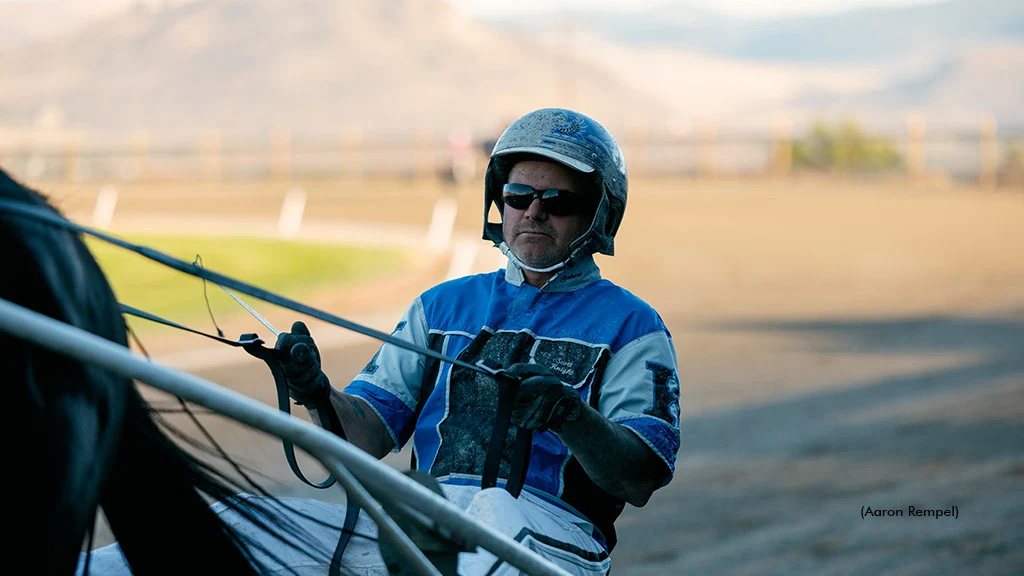
Scott Knight died at the age of 52 after a racing accident at Desert Park Raceway in Osoyoos, British Columbia, on Sunday, October 18, 2026. Standardbred Canada confirmed the death of the Western Canadian harness driver that evening. He was driving Wits Beach in the fifth race. This account brings together the published incident information and a documented look at his racing career, with updates checked on October 21.
The track's statement, republished by Daily Racing Form, said Dillon James, driven by Don Ross, broke stride and fell. Trailing horses and drivers could not avoid the fallen horse, resulting in a collision. Carson Abbott, driving Firm Ringo, was taken to hospital in Penticton; Ross was treated at the track. The announcement said the three horses involved survived. Those are the reported immediate outcomes, rather than a subsequent medical update.
The immediate aftermath and the limits of the public account
Officials stopped the remainder of Sunday's programme after race five. The contemporaneous race report identifies the final two races as cancelled, while the completed portion of the card remains in the published results. That distinction avoids suggesting that all races that afternoon were abandoned or that every earlier result was erased.
The venue also announced counselling support for members of the racing community. Kelly MacMillan, the Western Canada Horse Racing Association president and Desert Park operator, expressed the organization's grief and sympathy for Knight's family and those affected. The response was an immediate acknowledgement of a death within a closely connected racing community.
A later October 19 statement from British Columbia's Independent Gambling Control Office updated the horses' condition: one had been euthanized that day, while two survived and were being treated. The regulator said the other two drivers had been treated for minor injuries. Its account therefore supersedes the initial report that all three horses survived when describing the subsequent outcome.
The IGCO said it was examining whether applicable racing rules and safety requirements were followed, and that the BC Coroners Service was investigating. Those are announced inquiries, not findings of responsibility. The published sequence does not establish an equipment defect or a medical explanation for the initial fall. No final investigative conclusion is asserted here.
For readers encountering his name through the accident, the records below offer another necessary part of the story: Knight spent decades driving and training Standardbreds in Western Canada, and his career can be traced through actual races, milestones and representative competition.
Scott Knight's place in Western Canadian harness racing
Knight was a Langley, British Columbia horseman with a long association with Fraser Downs. In its announcement of his death, Standardbred Canada recorded a 27-year driving career encompassing 12,156 drives, 1,448 victories and more than $9.5 million in purse earnings. His training record was listed separately: 669 wins from 5,267 starts and nearly $4 million in purses. Those figures describe sustained work across many seasons rather than a reputation resting on one headline race.
Driving and training were separate parts of his work
In harness racing, the driver sits in the sulky behind the horse and makes the in-race decisions; the trainer prepares and manages the horse's racing programme. One person can perform both roles, but can also drive for another trainer. The two statistical records therefore should not be added together as though they counted entirely separate victories, and purse earnings should not be described as the horseman's personal salary.
A contemporary March 2013 Fraser Downs report makes the distinction tangible. Jans Rich Girl led a three-win training evening for Knight; Beach Boy Toy, another member of that winning group, was driven by David McKellar. The stable's success extended beyond the races in which Knight held the reins himself.
Another 2013 profile described his involvement in acquiring Dealers Edge and Thieving Magpie for owner Robert Collier. Both subsequently won featured races on the same February evening. That episode adds horse selection and knowledge of race eligibility to the career picture: the work involved identifying an opportunity for a particular horse and owner, then preparing for the appropriate contest.
Recognition beyond a single race result
The published list of British Columbia's 2013 award winners names Knight as Trainer of the Year in the category for trainers with more than 250 starts. The award was presented in the following year's ceremony. Keeping the category attached to the honor matters: it recognizes his work within that provincial programme, rather than implying a different national award.
For a reader whose usual reference point is Thoroughbred racing, our guide to the different racing disciplines explains the broader distinction. Knight's story belongs specifically to Standardbreds, sulkies and the Western Canadian harness circuit. His dual record and these contemporary accounts give a more accurate introduction than calling him simply a jockey or identifying him only with the accident.
Two race records that show the horseman behind the totals
Career totals tell us the scale of Knight's work. Individual race records show the decisions and partnerships within it. Two Fraser Downs victories, separated by almost eight years, offer particularly clear examples. They are different races with different horses and trainers, and neither needs to be turned into a claim that Knight followed one unchanging tactical style.
The 1,000th driving win with Wrangler Cat
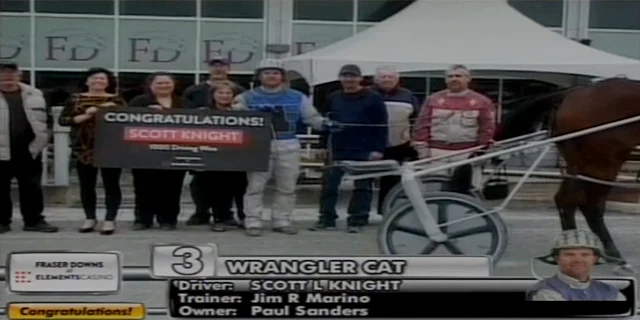
Knight reached 1,000 driving wins on April 22, 2017, in the second race of Fraser Downs' meet-closing programme. His milestone partner was Wrangler Cat, trained by Jim Marino. Standardbred Canada's contemporary race report describes Knight settling second before taking the lead early in the mile.
Wrangler Cat led the six-horse field through the opening quarter and halfway point. Pureform Pandora increased the pressure later, while Mach And Roll Baby also pursued in the stretch. Wrangler Cat held on by a head in a recorded 1:58.3. It was a narrow, contested finish to a career landmark, rather than an uncontested procession once the lead had been secured.
The sporting interest lies in the change of position and the later challenge. Going forward early established control, but the last part of the race still demanded a response to other horses. That is a useful way to remember the milestone: a particular horse-and-driver performance, with its trainer properly credited, inside a much longer working career.
A later first-over victory with Born A Spy
On March 27, 2025, Knight drove Rebecca Kanak's Born A Spy to victory in Fraser's $10,000 Fillies and Mares Preferred Handicap Pace. The published account records a different journey. After an early contest for position, Born A Spy settled third while the lead changed ahead of her.
She moved outside down the backstretch, advanced first-over and took command around the final turn. In High Cotton remained a challenger, but Born A Spy won by half a length in 1:55.1 over a track rated good. The victory extended the mare's winning streak to four; that sequence belongs to the horse's record, not to a claim that Knight won four consecutive drives.
“First-over” describes advancing on the outside without another horse providing cover immediately ahead. Compared with sitting behind a rival, it asks the horse to make its own progress through that part of the race. This example and Wrangler Cat's earlier lead-taking win show why a driving record contains more than one kind of journey. They preserve specific competitive moments without guessing what Knight privately thought or reducing the horses' contributions to a single driver's statistic.
What his regional championship selection represented
Knight's place in the wider circuit was also visible in representative driving competitions. Standardbred Canada's March 2024 announcement included him among eight drivers selected for the Western Regional Driving Championship at Century Downs in Alberta. The event formed part of the route to that year's National Driving Championship. An invitation was recognition of a driver's qualifying record and availability, rather than an award for winning the competition in advance.
The actual 2024 results provide a stronger measure than the selection announcement alone. Knight finished third on 56 points, behind Phil Giesbrecht on 62 and Mike Hennessy on 61. He won two legs, driving Blue Who and Five Star Dragon. That combination of leg victories and an overall third place records a competitive afternoon without turning participation into a championship title he did not win.
A format that tested drivers across different horses
The announced 2024 format spread the contest over eight races. Drivers participated in a horse-selection draft, with the order arranged so each had opportunities across the selection positions; the subsequent draw distributed starting positions. Points were earned from the official finishing order. The task was therefore to accumulate results with a changing group of horses, rather than to guide one outstanding horse through repeated rounds.
That structure makes consistency meaningful. A driver can win a leg and still need points in the next, where the horse, opposition and starting position differ. It also explains why the final standings should be read alongside the individual races. A single win shows one successful partnership; the overall total summarizes the whole sequence under the competition's rules.
Knight was selected again for the 2026 Western Regional. In that edition, the published final standings placed him sixth with 39 points; Giesbrecht and Kelly Hoerdt secured the two advancing positions. Those later results show continued participation in the representative circuit, while preserving the difference between being invited, competing and qualifying for the national event.
These are bounded sporting achievements. They do not establish a world ranking or mean every horse Knight drove had an equal chance. They do show that his career extended into a format built to compare drivers over multiple assignments. Alongside the training award and his Fraser Downs milestones, the championship record adds another specific way to understand his place among Western Canadian horsemen.
Why Desert Park was a significant new venue for the circuit
Desert Park was more than the location of Knight's final afternoon. It had recently become the venue for a new British Columbia Standardbred meeting, and Knight was part of its opening weeks. Understanding that setting connects the incident with the community in which he worked, without treating the new venue's existence as an explanation for what happened.
In a July 6, 2026 announcement, the Western Canada Horse Racing Association described its agreement with the Desert Park Exhibition Society and the Town of Osoyoos. The horsemen-led association would operate the racing programme at the equestrian facility. The announcement described a rebuilt five-eighths-mile harness track and an 810-foot homestretch. Its proposed opening timetable was still a plan at that stage.
The IGCO's October statement dates WCHRA's Temporary Race Track Operator Class licence to August 14, 2026. Licensing identifies the operator; it does not settle the cause of a later accident.
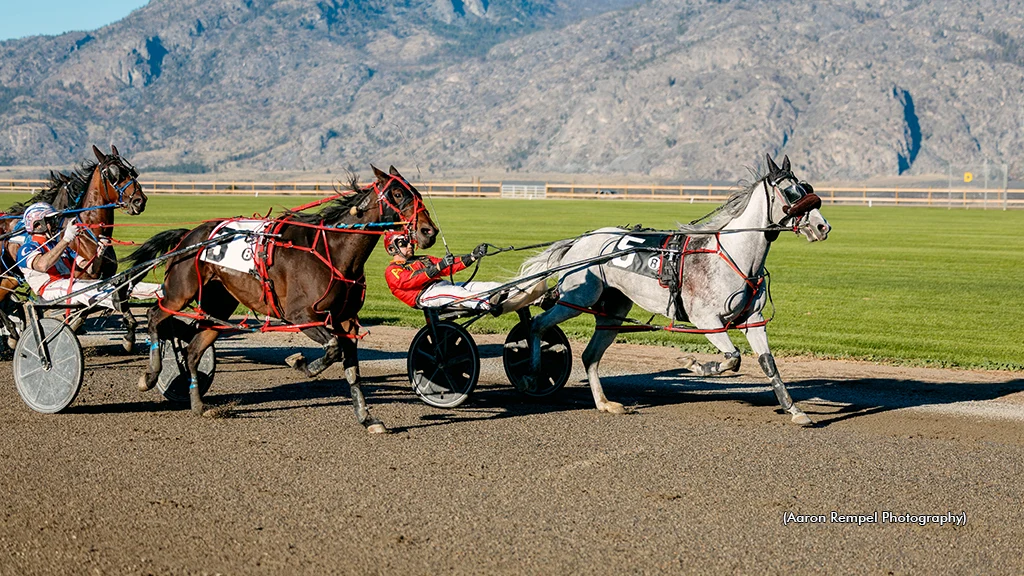
The actual opening-day report dates the inaugural meeting to September 27. It describes eight races and the return of harness racing to the province after the preceding Fraser Downs racing period. Knight reached the winner's circle with Avas Angel Baby for trainer Rebecca Kanak. The report also placed him second with Tahuya Sriracha in the meeting's first race.
On October 4, Knight and Avas Angel Baby won again, this time in the $17,000 Fillies and Mares Open Pace. The contemporary account describes the mare closing inside in a three-way finish after following the leaders. It is another concrete part of his record at the venue, distinct from both his long Fraser Downs association and the events of October 18.
The sequence matters: an announced project became a licensed operation, then a meeting with published results and familiar Western Canadian participants. For those horsemen, Desert Park formed part of their active professional lives. Preserving that chronology also prevents an old proposed schedule or an opening-day description from being mistaken for the latest information after the accident. Any later resumption requires its own current announcement and the regulator's stated requirements.
How the harness racing community is remembering Knight
Industry statements and support for his family
The response extended across the organizations and racing communities in which Knight had worked. Standardbred Canada's October 20 remembrance report carried statements from Harness Racing B.C., the Alberta Standardbred Horse Association and the United States Trotting Association. Their messages recognized a colleague and community member as well as a successful horseman.
Harness Racing B.C. described Knight as a current director who represented industry members. That role adds another dimension to the public record. Racing careers involve relationships among owners, trainers, drivers and the organizations representing them; Knight participated in that representative work as well as the races themselves.
ASHA announced support for his family through a fundraising initiative and its Homestretch Assistance Program. The family support campaign explains that its purpose includes funeral expenses and the financial pressures following the sudden loss. Its running total can change, so a sum reported in an earlier story should not be treated as the present amount.
USTA executive vice president and CEO Mike Tanner also conveyed condolences to Knight's family, friends, others involved in the accident and the Canadian racing community. Those statements express the reach of the loss. They are tributes and support messages, rather than evidence about why the collision occurred.
Following confirmed updates with care
The October 19 regulator statement did not identify the euthanized horse. Assigning a name from the order of the collision would go beyond the published facts.
The racecard and the result also serve different purposes. An entry list can continue to show horses nominated for races that were later cancelled; it does not prove those races took place. The official October 18 result records the completed races, while the race report explains the shortened programme. Our guide to reading results explains the distinction using American Thoroughbred charts; the specific Canadian harness record remains the appropriate source here.
Service arrangements and any further family announcement should be traced to Knight's family or a clearly identified industry notice. A matching name in an unrelated obituary is insufficient. His documented legacy is already substantial: horses prepared, races driven, a thousand-win milestone, representative competition and service to the racing community. Those records allow him to be remembered for the work that preceded the final afternoon.
Join the conversation
Have a question or a race-day tip to share? Keep it friendly and on topic. Comments appear after review.
No comments yet. Start the conversation.
Sign in with Google to leave a comment.