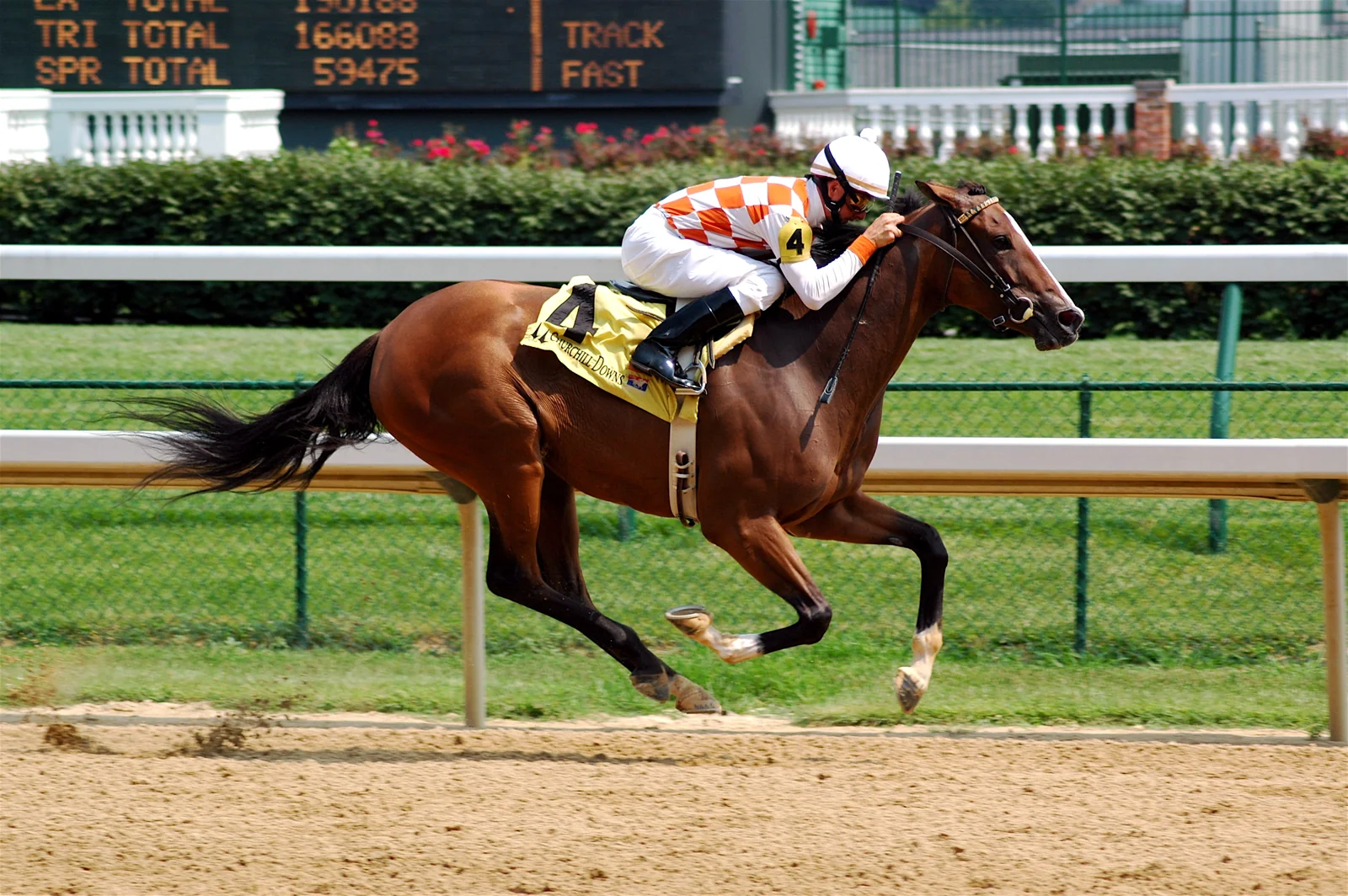
The main types of horse racing differ in what horses and riders must do: gallop on a flat course, maintain a prescribed harness gait, negotiate obstacles, or complete an endurance course with veterinary qualification. Breed, surface, distance and race class add further descriptions. This guide helps you separate those layers and find the event you actually want to watch.
Cover photo: Jeff Kubina, CC BY-SA2.0; July 2006, resized and converted to WebP under the same license.

Identify the racing format before reading the race class
The fastest way to identify a race is to ask what the horse and the person guiding it are doing. Flat racing has no scheduled jumping obstacles. Jump racing introduces hurdles or fences. In the familiar North American harness format, a driver sits behind the horse in a lightweight cart called a sulky. Those distinctions tell you how to watch the contest before you start reading its level or purse.
| Format | First visible clue | Useful next question |
|---|---|---|
| Flat | Mounted jockeys, no jumping course | Which breed, distance and surface? |
| Harness | Horses pulling sulkies with drivers | Is this a trot or a pace? |
| Jumps | Mounted riders negotiating obstacles | Hurdles or fences, and under which rules? |
| Endurance | Long-distance course with inspection stages | What completion and fitness requirements apply? |
This is a viewing map, not a rule that every horse sport must fit four exclusive boxes. Breeds, race conditions and national terminology add other descriptions. A Quarter Horse sprint is still a flat race, for example; its breed and format describe different parts of the same event. You can also encounter exceptions whose names make more sense once you know the governing code.
Two official educational starting points illustrate that separation. Britain's Jockey Club racing guide organizes its introductions around Flat and Jump racing. The US Trotting Association's guide to drivers explains the person sitting in the sulky. Neither requires you to confuse the activity with a race's championship status.
Once the format is clear, read the actual event conditions. A Grade 1 description does not tell you whether you are watching a sprint, a long route or a hurdle race without the rest of the information. The sections below give you the visual clues and the questions that keep those labels in their proper place.
Thoroughbred flat racing: the familiar racecourse contest
Thoroughbred flat racing is the format many American fans first encounter through the spring classics. Jockeys ride the horses, and the course contains no scheduled hurdles or fences. The word flat describes that absence of jumping obstacles; it does not require every racecourse to be a perfectly level oval with identical turns.
Dirt, turf and synthetic are surfaces, not separate codes
A dirt race and a turf race can both be flat racing. Turf means grass; synthetic describes an artificial racing surface. The surface tells you where the competition happens, while the code tells you the kind of competition. Keep both descriptions when reading a card rather than treating them as competing answers.
For viewing, this gives you a useful comparison rule: start with races on the same surface and over a similar distance before assuming a horse's last finish describes today's assignment. A surface change is a question to examine, not an automatic improvement or downgrade. Read the announced conditions and any changes to the race you are actually about to watch.
The British official flat-racing explanation is a useful reminder that the basic format survives different course layouts. Country and venue still matter when you interpret the rest of the card. A term used in one region is not a promise that another jurisdiction classifies everything the same way.
A sprint and a route ask different questions
In the US convention illustrated by Equibase's sample reading guide, sprints are under one mile and routes are one mile or longer. A furlong is one eighth of a mile. Thus a hypothetical six-furlong sprint covers three quarters of a mile, while an eight-furlong race covers one mile. The sample is educational material, not today's entries.
The extra distance changes what you should observe. In a short race, pay attention to the start and how quickly the field establishes positions. In a longer assignment, also follow how the early effort connects to the final stages. Neither observation tells you that only front-runners win sprints or only closers win routes. It gives you a better question about the performance.
Take two imaginary races with the same winner's name but different distances. Saying the horse won both is useful; comparing the raw final times as though the distances were equal is not. Write distance and surface beside each result before interpreting speed, stamina or an apparent change of form.
Quarter Horse racing and the importance of the start
Quarter Horse racing supplies a distinct short-distance viewing experience within flat racing. The familiar quarter-mile reference means 440 yards, not 55 yards. Do not turn the breed's name into a rule that every race must cover exactly that distance, or that no contest can be longer.
For a concrete example, Remington Park's official March 28, 2026 Distance Challenge chart identifies an 870-yard race. That single published event is enough to expose the mistake in describing all Quarter Horse races as quarter-mile contests. Read the yards printed for your race instead of relying on the familiar label.
In a short straight sprint, watch from the gate opening. Notice whether the horse leaves cleanly, holds its line and gets into its racing effort promptly. A clip that begins near the finish can conceal much of the contest's development. The short assignment makes those first movements particularly useful to examine, but it does not justify saying every imperfect start makes winning impossible.
Suppose you choose a hypothetical 350-yard race to watch. Your first task is to follow the runner from the start, not wait for a series of turns to provide orientation. On a second viewing, compare the opening strides of the nearby opponents. This helps you describe what you can see without inventing a precise time lost from a camera angle or declaring that the fastest-looking horse must have won.
Then confirm the official result, especially when the finish appears close. The event's distance, breed restrictions and any qualification conditions belong with the outcome. A trial and a final are different stages even if both look like a fast sprint. The useful habit is the same as in Thoroughbred racing: identify the actual assignment first, then interpret how the horses performed it.
Harness racing: horses with sulkies and drivers
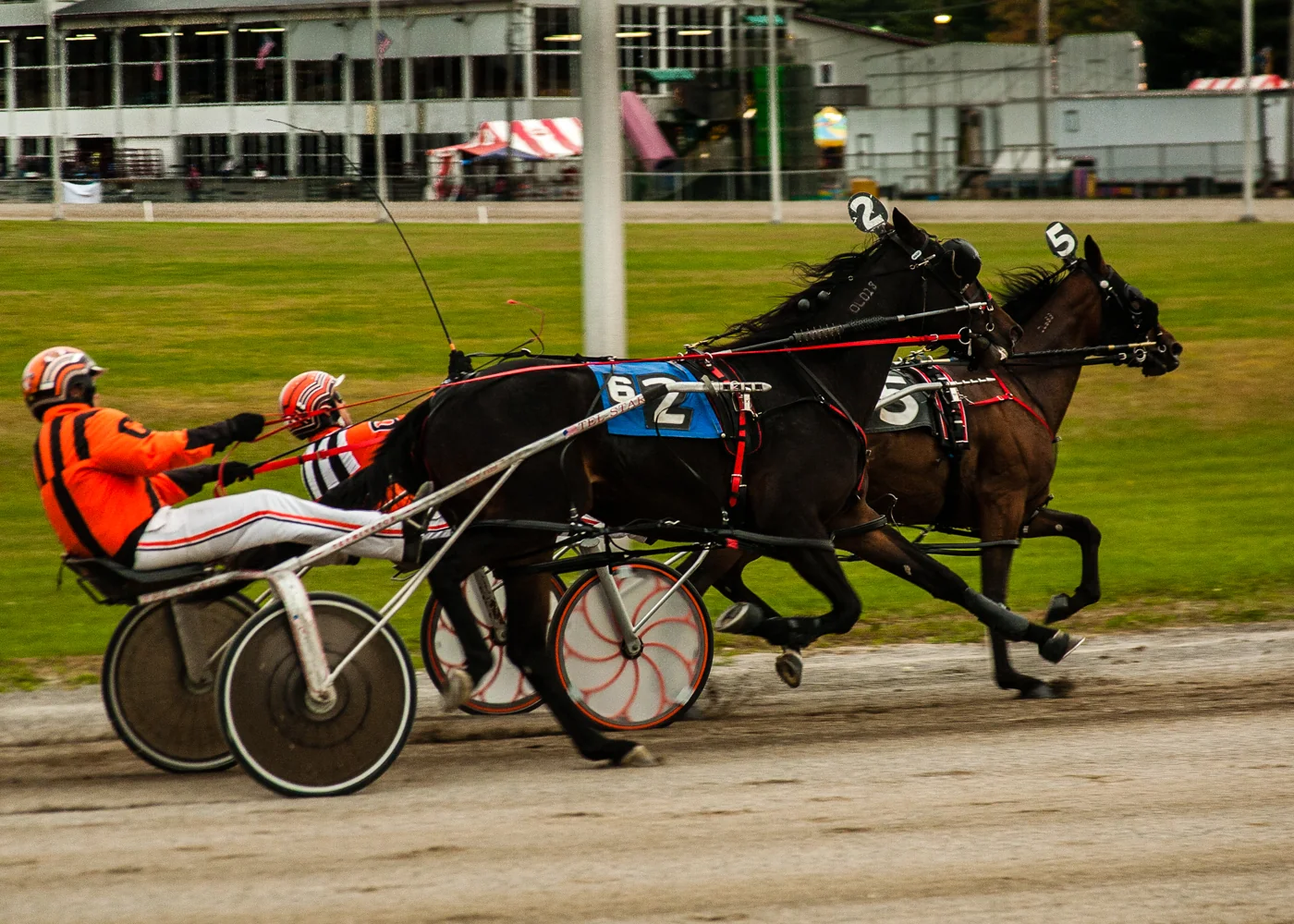
The horse races with a driver behind it in a sulky, rather than a jockey mounted on its back. This is the familiar North American Standardbred harness scene. It is the answer many new fans need when they search for horse racing with carts. Regional variations exist, so the following explanation focuses on that recognizable format.
Trotting and pacing are different gaits
A trotter moves its legs in diagonal pairs; a pacer moves the legs on the same side together. The USTA's racetrack guide explains the distinction and that a race is contested at its specified gait. Galloping is therefore not simply a faster version of doing the same job.
When a harness horse goes off-stride, the change matters to the competition. Read the race's official decisions rather than treating an apparent burst of speed as proof of legal progress. You do not need to predict a particular penalty from a short clip to understand that maintaining the gait is part of the assignment.
Equipment can help you recognize the scene, but should not replace the event label. The USTA's equipment guide describes hobbles used to help maintain gait, including different arrangements for pacers and trotters. A still photograph may show those loops; the program tells you what race you have selected.
Watch the mobile gate and the racing position
A common start uses a moving vehicle with extended gate wings to bring the horses to the line. Watch the approach, then continue following your chosen runner as the field establishes its positions. The gate scene is different from horses leaving stationary Thoroughbred stalls.
For the rest of the race, study available room as well as position. A horse following the leader on the inside may have a short path but need an opening. An outside runner may have room to advance while covering more ground. These are competing demands, not a rule that one position guarantees the winner.
Try following the same race twice: first your runner, then the horse immediately ahead. Notice how that opponent's movement affects the route available to your selection. The sulkies make the spatial problem especially visible. Use the USTA's harness terminology guide for unfamiliar commentary, then match the description to what the footage actually shows. A finish position alone cannot describe every decision along the way.
.jpg)
Jump racing: hurdles, fences and the bumper exception
Jump racing adds an obstacle task to the contest between horses. For a newcomer, the useful first question is what the runners must negotiate. A clean, economical jump can preserve position and rhythm; a mistake can change the race long before the finishing straight. The official race type tells you which task to watch.
Hurdles and steeplechases require different jumping tasks
In the British distinction, hurdles are smaller, flexible obstacles, while steeplechases, usually called chases, are run over fences. The Jockey Club's guides describe hurdles and the variety of obstacles in a steeplechase, including fences, water jumps and open ditches. Those descriptions explain a difference in assignments; they do not make every country's courses identical.
American terminology requires another check. The National Steeplechase Association's sport overview places hurdle and timber races within US steeplechasing. Consequently, hearing steeplechase in an American broadcast does not necessarily mean precisely the British chase category. Read the event conditions before comparing two performances carrying that broad label.
On replay, select one obstacle and watch the approach, takeoff, landing and return to a racing rhythm. Then compare that sequence at the next obstacle. This makes an apparently sudden change in position easier to understand. A horse can lose ground without having reached the part of the race where a flat-racing viewer expects the final acceleration.
A National Hunt flat race has no obstacles
A bumper is the important exception to a simple visual rule. The Jockey Club defines it as a flat race conducted under jump-racing rules. Its bumper guide also explains that the start uses tapes rather than ordinary flat starting stalls. The words National Hunt flat on a British program therefore belong in this discussion even though nobody jumps an obstacle.
Suppose you open a jump meeting and its final race appears to be an uninterrupted gallop. Check the label before concluding that the feed has switched to another meeting. This small habit prevents a much larger mistake: judging the race using an assumption about its category instead of reading the actual program. It also explains why a schedule organized only by photographs would be less useful than one carrying the proper race description.
Endurance riding is a different kind of competition
Endurance belongs in a broad guide to competitive racing with horses, but it is a different spectator experience from a racecourse card. The FEI describes a trail discipline organized over long distances, with loops and mandatory veterinary inspections and rest periods. Its endurance introduction explains that horses must be judged fit to continue and that passing the final inspection matters to completing the competition.
That final qualification is an essential difference. A photograph of a rider crossing a line is not sufficient evidence of an official completed result. Look for the published competition classification. The sporting task combines progress over the course with meeting its welfare requirements; speed cannot be read in isolation from the horse's continuing eligibility.
The viewing question changes as well. On a conventional flat card, you might set aside time around one short race. With endurance, follow the event's stages, its intermediate standings and the official finish status. A long interval without a dramatic finishing shot does not mean nothing relevant is happening. A pair's progress from one stage to the next belongs to the story.
Do not compare its headline distance with a Thoroughbred sprint and conclude that one horse must simply be a slower version of the other. Different courses and competition demands produce different kinds of performances. A useful comparison is within the same endurance event: where competitors stand, which stages they have completed, and whether their status permits them to continue. Even then, use the organizer's explanations of what the displayed timings include.
For planning purposes, start with the endurance organizer or federation's event information. A US racecourse schedule may be excellent for finding an afternoon of Thoroughbred races while saying little about a separate trail competition. That is a difference in the event you are seeking. Naming it accurately saves you from searching an unsuitable calendar or mistaking a missing racecourse entry for a cancelled endurance ride.
Choose the right schedule and read the conditions
Start with the kind of competition you want to see, then find its organizer and date. Our today's schedule and track directory provide useful starting points for a racecourse afternoon. For a particular harness, jump or endurance event, also consult the relevant track, organizer or federation. Check the named meeting before assuming that a general horse-racing calendar contains the event you have in mind.
Within a meeting, keep the race number and date together. Race 4 is not a permanent name; the same venue runs a different Race 4 on another day. Read the stated time and its time zone, then verify that the race is still scheduled. This is especially helpful when switching between a local visit and a foreign broadcast. A familiar track name does not make the displayed time your local time.
Breed, eligibility and grade belong on different lines
Consider an imaginary US Thoroughbred race described as six furlongs on dirt, for maidens. Thoroughbred identifies the breed category; six furlongs gives the distance; dirt gives the surface; maiden describes an eligibility condition. These details answer different questions about the same contest. Maiden does not mean all the horses are racing for the first time: in this familiar flat-racing use, they have not yet won.
A maiden claiming race adds another condition: the horses are eligible to be claimed. Equibase's race-class explanation separates these descriptions. The example shows why a list that places dirt, maiden and Thoroughbred beside flat and harness as interchangeable types would confuse a new reader. One horse race can carry several of those descriptions at once.
A stakes grade is another layer. TOBA's American graded-stakes guide explains the hierarchy of Grade I, Grade II, Grade III and Listed, with Grade I highest. It describes assessed race quality, rather than a different gait or obstacle format. Consult the appropriate year's designation when looking through the major-race calendar.
Finally, watch one race with its conditions beside you. Ask what the horse was required to do, what happened during the contest and what the published result confirms. That sequence builds a more useful understanding than memorizing an enormous list of labels. Once the format is clear, the breed, surface, distance and class help you explain the particular race you actually watched.
Join the conversation
Have a question or a race-day tip to share? Keep it friendly and on topic. Comments appear after review.
No comments yet. Start the conversation.
Sign in with Google to leave a comment.