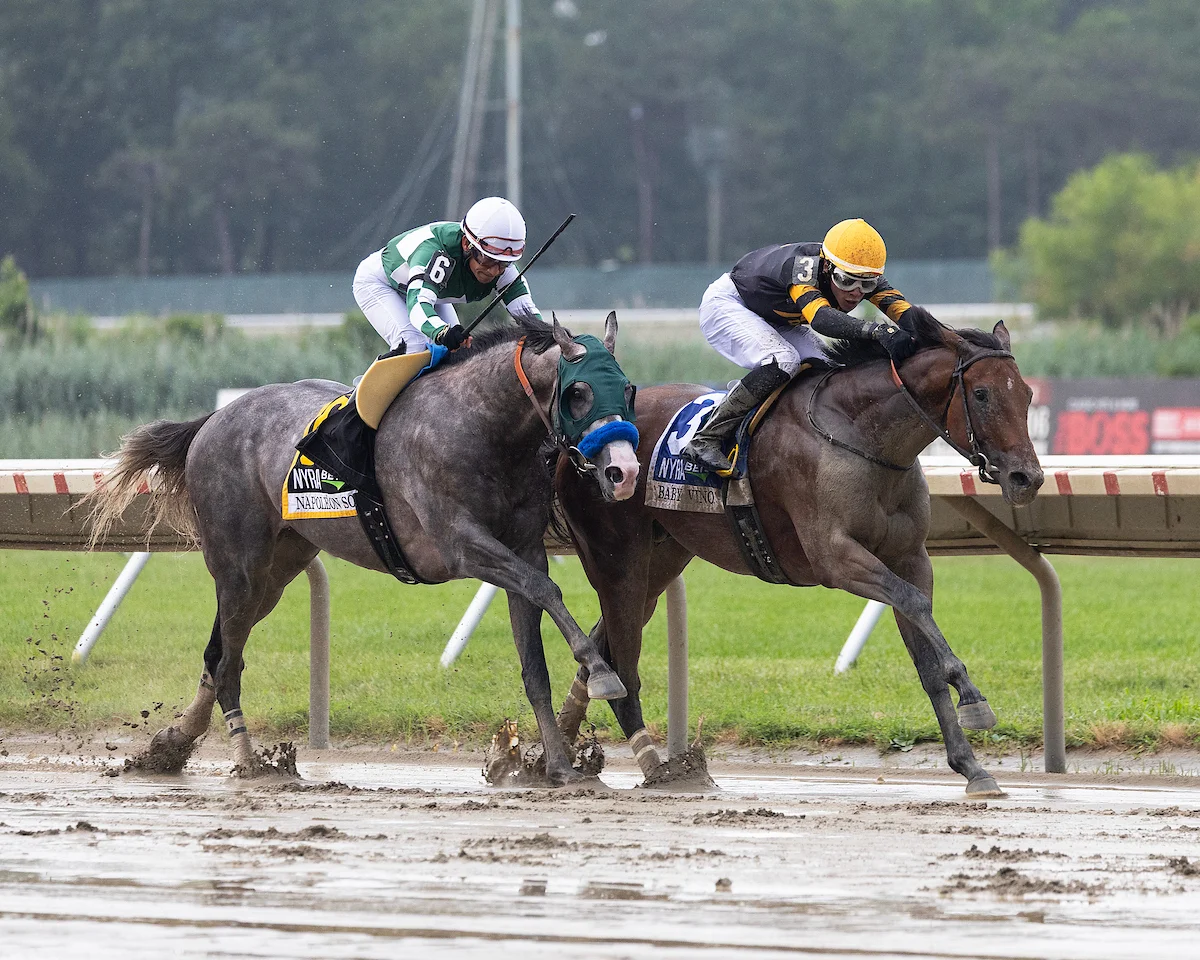
The most useful horse racing betting tips for beginners explain how to reach a decision, rather than hand you an unexplained selection. Start with affordable limits and the race conditions, compare relevant form, consider how the field may run, then decide whether the price and ticket fit your opinion. This US guide uses hypothetical examples to make those choices clearer; none is a prediction for today or a promise of profit.
Start with the race conditions and a spending limit
The most useful horse racing betting tip for a beginner is to understand the race before trying to name its winner. Write down the course, date, race number, distance and surface, then read the conditions that determine which horses can run. A familiar name in an unfamiliar contest is a poor substitute for that first step.
Set your spending limit separately, before prices or persuasive selections make the decision emotional. It should be money you can afford to lose, with travel, admission and information purchases accounted for outside the betting stake. NYRA Bets’ responsible-wagering guidance emphasizes affordability. A limit is a boundary, not a target you must exhaust before leaving.
You can also begin with paper selections: write what you would choose, the price available and your reasons, then follow the race without placing a wager. That gives you the same opportunity to test whether you understood the contest without treating every lesson as a paid experiment.
Choose a manageable card before looking for selections
Choose one course and a small number of races you have time to understand. Trying to analyze every race appearing on a multi-track screen can produce many opinions with little explanation behind any of them. A beginner gains more from following a few fields closely than from collecting a long list of names.
Find the appropriate program or past performances. Keeneland’s official resources, for example, include a complimentary digital program during its spring and fall meetings. That is a course-specific opportunity, not a claim that every information product for every track is free. Confirm the date and field before relying on a saved file.
Set one question for each race: does the distance suit the main contenders, is there a likely struggle for the lead, or does the favorite face a different challenge from its latest win? The question keeps research focused. A tipster’s selection can then be compared with your reasoning instead of becoming the reason by itself.
Do not choose a race solely because you need action between two events you came to watch. The today schedule helps identify the card; it does not make every listed race an opportunity for you. If you cannot explain the conditions or obtain the information you need, keep it as a viewing race and move on.
A manageable beginning also makes later review more honest. You will remember what you expected to happen and where uncertainty remained. That is a better foundation than discovering after the result that your entire argument was a confident sentence copied from someone else.
Compare form that is relevant to today's race
The latest finishing position is a starting point, not a complete assessment. A second place can reflect a strong effort against demanding opposition, while a win can come in a race that asked less of the winner. Compare what each horse did with what it was being asked to do.
Distance, surface and company change the question
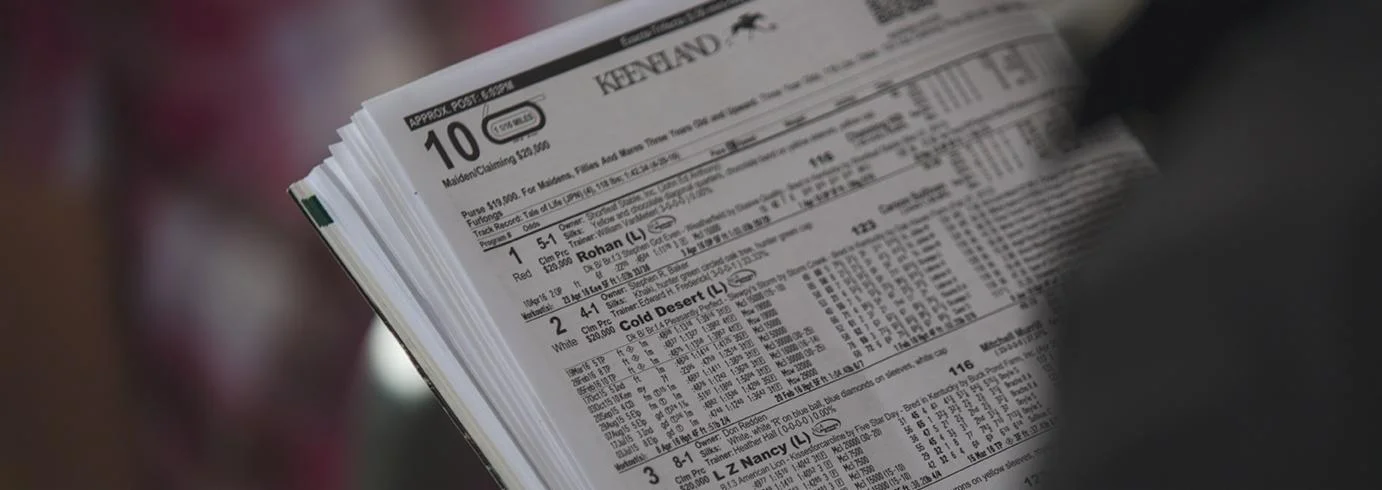
Read the distance and surface beside each previous run. Six furlongs and a mile are different assignments, and a performance on grass is not automatically a demonstration of the same ability on dirt. DRF’s past-performance guide explains the labels that let you make those comparisons.
Build a small table for your main contenders: relevant distance evidence, relevant surface evidence and level of opposition. Include a short note about the performance itself. “Won last time” should become something more precise, such as “won over a shorter distance against a less demanding field.” The second description gives you a question to investigate rather than a conclusion to accept.
Imagine Runner A finished second against stronger company over today’s distance, while Runner B won a shorter race against weaker opposition. A has relevant experience; B has a recent win and a new task. Neither automatically outranks the other. Look at the margin, race shape and evidence that B can reproduce its effort over the longer trip.
Class labels help identify the challenge, but they do not replace the field. NYRA’s handicapping explanation cautions that performances need context when horses move between levels. A class drop can change the competition without proving why the horse has been placed there. Avoid diagnosing an unreported physical problem from an entry decision alone.
A speed figure needs a race around it
A speed figure offers a way to compare performances beyond raw times. DRF explains that a Beyer figure considers time, distance and the track variant. Its comparison is a measure of past performance, not a promise that a horse will repeat it under every future set of conditions.
Use figures from the same system when making a direct numerical comparison. Then inspect the pattern. A hypothetical runner with figures of 78, 80, 90 and 79 has shown a peak, but the peak is not its entire record. Another with repeated figures around 84–86 presents a different question about consistency. Those invented numbers illustrate a reading method; they are not ratings of today’s horses.
Ask what surrounded the exceptional effort: distance, surface, pace and the trip through the race. Do not automatically discard a high figure as a fluke, or automatically treat it as the new normal. The evidence may support either interpretation, or leave the question unresolved.
Write your conclusion conditionally: “This horse has already run well under comparable conditions, but needs to repeat that level against this field.” That is a useful betting opinion because it states both the evidence and the dependency. “Highest number wins” leaves out the race still to be run.
Build a pace scenario for the whole field
A horse does not run its race in isolation. Before choosing one, sketch where the others are likely to be early: seeking the lead, sitting close behind it or waiting farther back. You are making a provisional map, not predicting every stride. The useful question is which runners may help or hinder one another.
NYRA's pace guide explains why competing front-runners can create pressure, while an uncontested leader may conserve energy. A slower early pace can leave a closer with more work to do late. These are possibilities to test against the field, rather than rules that make every contested pace a closer's race.
Consider an invented field with three runners central to your analysis. A usually wants the lead. B has also done its best work near the front. C settles behind the leaders and finishes strongly. C's case becomes interesting if A and B insist on their preferred positions and spend energy competing. But ask whether B has previously settled comfortably behind another horse. If it has, your supposedly fierce duel may never happen.
Look beyond the finishing position in each previous race. A runner that finished fourth after contesting the lead may have faced a different task from one that finished fourth after an economical trip behind the pace. DRF's past-performance definitions distinguish running positions and margins from the fractions recorded for the race leader. Do not assign the leader's fractional time to every horse in the field.
Your note can be short: “A and B may compete early; C needs that pressure and a clear opportunity to finish.” It is more informative than writing “C is due a win.” It also gives you something observable to revisit afterward. If the race unfolds differently, identify which assumption failed instead of inventing a new explanation for the selection.
Reconsider the picture after scratches
A scratch means a horse is withdrawn before the start. Return to your pace map when the field changes. In the example, removing B removes one reason for expecting pressure on A. C may still be capable, but the particular argument you made for C is now weaker.
That does not automatically make A the correct selection. Other runners may change tactics, and A still has to handle the distance, surface and opposition. The practical response is to reassess, including the option of passing the race. Read the latest official field and announced changes before acting on a morning analysis. A neat explanation is useful only while the circumstances supporting it still exist.
Put a price beside your opinion
Choosing the runner most likely to win and deciding whether to back it are different decisions. A favorite can be the strongest horse in your analysis and still offer a return too small for the uncertainty involved. Conversely, a large price does not turn an unconvincing runner into a sound selection. Start with the race argument, then ask what price would make that argument interesting.
The morning line forecasts how the public may bet. It is not the oddsmaker's personal ranking of winning chances, and it is not a promise of the price you will receive. In pari-mutuel betting, the displayed odds change with wagering. A selection that looked attractive in the morning can become less appealing as its potential return falls.
A simple invented example shows why price matters. Suppose you judge a runner to have a one-in-four chance of winning: 25%. That is your estimate, not a measured fact about the horse. At exactly 3/1, a winning $2 bet returns $8 including the stake. Over an imaginary set of four equivalent bets with one winner, you would spend $8 and receive $8. That is the break-even price implied by your estimate.
At exactly 2/1, the same winning $2 bet returns $6. With the assumed 25% chance, its average return would be $1.50 per $2 staked, a loss of $0.50. At exactly 4/1, the return is $10 and the assumed average is $2.50, or $0.50 above the stake. These are idealized calculations at the stated odds, before any payout rounding. They demonstrate the relationship between chance and price; they do not establish that your 25% estimate is correct.
That last distinction matters most. Beginners can make an arithmetic calculation accurately while supplying it with an overconfident probability. If you have not accounted for a credible rival, uncertain fitness or a possible pace change, your estimate may be wrong. Writing a precise percentage does not remove those gaps. Treat your proposed minimum price as a disciplined way to state an opinion, rather than proof that you have found a profitable bet.
Record the price you were willing to accept before seeing the result. If the odds become shorter than that threshold, passing is a coherent decision. If they lengthen, revisit the race argument instead of assuming the public must be mistaken. You can enjoy watching a runner you assessed correctly without having a ticket on it. The lesson is to make the price part of the decision, not an excuse constructed after the horse wins.
Make the ticket fit the opinion and review the outcome
A thoughtful selection can still become an illogical ticket. State what you believe will happen before choosing the bet: one runner to win, two to finish first and second in a particular order, or a set of winners across consecutive races. Those are different predictions. Do not choose a complicated wager simply because its possible payout is more exciting.
More combinations need a stronger reason than more coverage
An exacta requires the first two finishers in order. A box covers possible orders among your selected runners. The TwinSpires wager-cost guide explains that an exacta box has the number of selections multiplied by one fewer selection in combinations. Each combination carries the chosen base stake.
With three distinct runners, a hypothetical $1 exacta box costs 3 × 2 × $1 = $6. With four, it costs 4 × 3 × $1 = $12. Adding one horse doubles the expenditure; it does not establish that your chance of success has doubled. You have bought additional finishing orders, including orders that may have little support in your analysis.
If your real opinion is that No. 4 wins and Nos. 2, 6 or 9 could finish second, a hypothetical $1 exacta using 4 over 2, 6 and 9 covers three combinations for $3. It loses if No. 4 finishes second. That limitation is part of the prediction, not an error to repair by automatically buying every reverse order. Check the available bet and minimum stake for the particular race before constructing it.
For a newcomer, learning to express one opinion clearly can be more useful than spreading small stakes across numerous alternatives. If you cannot explain why an added runner belongs in a finishing position, reconsider the addition. If the combinations needed to represent your uncertainty exceed your spending limit, leave the race alone. Reducing the base stake helps only when the resulting ticket remains an affordable and intelligible decision.
Keep the original reasoning alongside the result
Keep a short record before the start: race conditions, selected runner, principal rival, expected pace, minimum acceptable price and intended stake. Save the original note. Rewriting it after the result removes the evidence you need to learn whether the analysis was sensible. Record a race you watched without betting as a practice exercise, clearly separate from money actually staked.
Afterward, find the race through our race results, then use its corresponding official chart or result and, where available, the replay to compare expectation with events. Did the anticipated leaders compete? Did your runner receive the trip you expected? Was the performance weaker than your case suggested, or was an important assumption about the field wrong? Running positions and chart comments can guide that review, but avoid claiming unseen trouble merely because a selection lost.
Track total stakes and total returns as well as winning tickets. A winner can leave the day's overall account behind; a good result does not prove every reason offered for it was sound. Likewise, one loss does not settle whether a method works. Look for specific recurring mistakes, such as comparing unsuitable form or ignoring a late change, rather than treating a short run of outcomes as a verdict on your ability. The aim is a clearer, more honest understanding of the next race, within the same spending limit.
Join the conversation
Have a question or a race-day tip to share? Keep it friendly and on topic. Comments appear after review.
No comments yet. Start the conversation.
Sign in with Google to leave a comment.