
To bet on a US horse race, choose the correct track and race, understand the finishing condition of your wager, check its full cost and verify the accepted ticket. Start with a spending limit you can afford to lose. This beginner guide explains ordinary pari-mutuel tickets with hypothetical amounts, including why a place bet, an across-the-board ticket and an exacta box cost and pay differently. It offers no selections or promise of a profit.
Start with one race and a fixed spending limit
A useful first lesson is understanding one ticket completely. Choose one race to study, identify the horses, decide what finish your bet requires and know its total cost before submitting it. That is a more manageable task than learning every wager on a crowded card while the next race is approaching. You can watch the rest of the programme without betting on it.
Set the maximum amount you are comfortable losing before the session begins. Keep that money separate from admission, travel, food and other expenses. The NYRA Bets responsible gaming guidance stresses affordable wagering and personal account use. A spending limit is a boundary for the outing, not money that must be exhausted because you brought it.
For an illustrative learning plan, someone might set aside $20 but begin by studying a single $2 wager, if that amount is offered. The other $18 does not need another purpose immediately. They could make no further bets and still learn from the race. This is a hypothetical budget, not a recommended stake for your circumstances or a method of protecting you from a losing selection.
Do not raise the limit after a loss to make the afternoon feel successful. Nor does a win require a larger next ticket. The result of one race does not change the rules of the next wager or make its outcome certain. For beginners, the most useful measure of progress is whether you can explain the ticket you placed and its settlement afterwards.
Know where you are allowed to wager
Use a permitted track service or a licensed operator available to you, and check its current age, residence and location requirements. Downloading an app does not itself prove you are eligible. For example, NYRA Bets' terms specify age and lawful-jurisdiction requirements and address wagering while travelling. Those are that operator's conditions, not a universal promise that every US state or every visitor can use it.
Check these questions before sending money to an account, rather than discovering an access problem minutes before post time. Use your own verified account, complete the required identity process and read the funding conditions. If you are attending in person, ask the venue which facilities you may use. Race admission and permission to place a wager answer different questions, and a friend being eligible does not transfer that eligibility to you.
Match the bet to the finish you are predicting
Choosing a horse and choosing a wager are different decisions. You may think a runner can win, or simply expect it to finish near the front. The ticket needs to express that opinion accurately. Check which pools are offered for the particular race and the permitted minimum stake; the dollar examples below illustrate costs rather than a minimum that applies everywhere.
Win, place and show are separate bets
The Keeneland betting guide defines the basic US finishes: a win bet requires first place, a place bet requires first or second, and a show bet requires first, second or third. A show selection does not have to finish exactly third. Equally, a win bet does not pay because the horse ran a respectable second.
The bet still belongs to its own pool when the horse exceeds the minimum finishing requirement. A show bet on the winner pays the official show price, not the win, place and show prices added together. Buying the show ticket alone does not create a win ticket as a bonus. That distinction matters when you read the result screen's three payout columns.
A broader qualifying finish is easier to describe, but it is not a guarantee that the horse qualifies or that the session makes money. Read the bet as a sporting requirement, then read its official payout separately. You cannot calculate a place or show return by simply taking a fixed fraction of the horse's displayed win odds.
Across the board means paying for three wagers
As NYRA's wagering explanation describes it, across the board is an equal-amount win, place and show bet on one horse. At $2 per part, you spend $6 altogether. The following table assumes ordinary official finishing positions and that those pools are available.
| Horse's official finish | Qualifying parts of the ticket |
|---|---|
| First | Win, place and show |
| Second | Place and show |
| Third | Show only |
| Outside the first three | None |
Here is an invented payout example, not an actual result or predicted price. If that $6 ticket's horse finishes third and its $2 show part returns $4.20, the ticket returns $4.20 in total. The other two parts lose. Subtracting the full $6 cost leaves a $1.80 loss, despite having a qualifying show wager. Always compare the money returned with the entire amount spent.
Understand the price before expecting a payout
This guide concerns ordinary US pari-mutuel racing bets. Wagers of a particular type enter a shared pool, and the final distribution determines the winning payout. The Keeneland wagering explanation describes how incoming money changes the market until betting closes. A displayed price before the start is therefore not a fixed-odds promise attached to your ticket.
The track's takeout is deducted from the pool before its distribution. Do not subtract an arbitrary takeout percentage again from a published official payout when checking a small ticket. Use the actual payout and its stated base amount. Different bet types have different pools, so a win price cannot supply a place, show or exacta payout by a simple conversion.
Fractional odds describe profit relative to stake. In a purely mathematical illustration, exactly 5/2 on a $2 win stake means $5 profit and $7 total return, including the $2 stake. The TwinSpires beginner guide explains that distinction. This is not an actual race quote or a replacement for the posted official price and applicable payout rules.
Morning-line odds are not the final betting price
Keeneland's odds dashboard separates the morning line, the current market and projected final odds. The morning line is an early estimate; live odds reflect current betting; a projection is still an estimate. Keeping those labels separate is more useful than copying the first number you saw into a note marked “my price.”
Suppose you liked a horse when the early line looked attractive but the live win price is much shorter near the start. That is a new price question, even though the horse is unchanged. You can watch without betting if you do not understand or want the revised situation. Do not treat the original estimate as a return the operator owes you.
Final odds may appear on a display after the field has started because the final pool is being reflected. NYRA's betting FAQ distinguishes that display delay from taking bets after the start. For the beginner's ticket, the practical lesson is to rely on the eventual official payout rather than a last-minute screenshot or a remembered number from the morning.
Place the ticket and check what was accepted
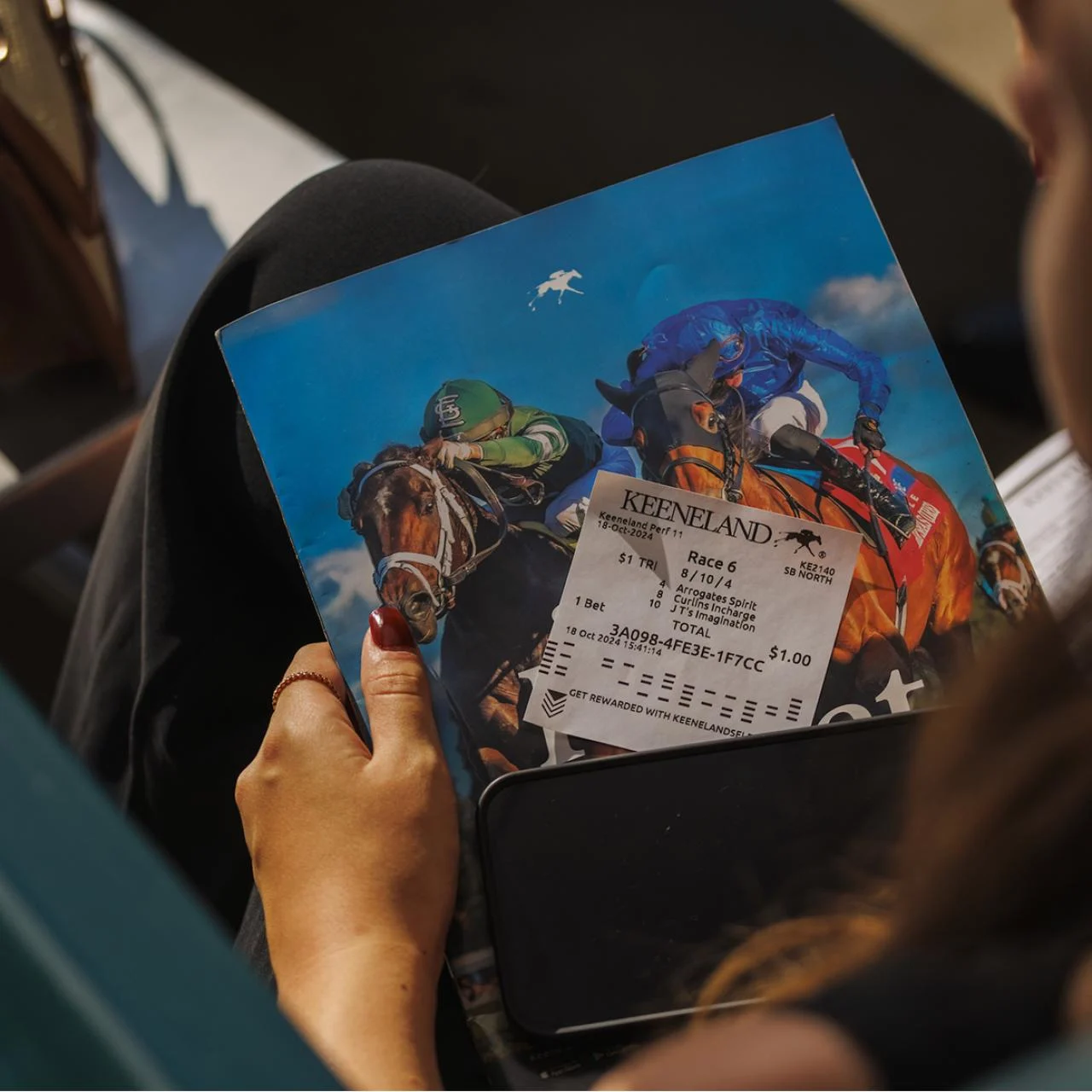
Make the selection before approaching the window. Keeneland's betting instructions give a useful order: track, race number, amount, bet type and horse number. For a hypothetical single, that might be “Keeneland, race three, two dollars to win on four.” The example explains the sentence; it does not recommend a horse or confirm that today's race three has that runner.
The track name matters even when you are standing at a racecourse. A venue may offer betting on races taking place elsewhere. Race three at one track is a different event from race three at another. Likewise, use the horse's listed program number, not its name alone or a remembered position in the starting gate. Check the current racecard rather than reconstructing the selection from yesterday's program.
Read back the ticket while there is still time to identify a mistake. Check the venue, race, runner, wager type and total amount. If you wanted one $2 win wager but see a different type or a larger charge, raise it immediately with staff. Do not wait for the result and then assume the unwanted ticket can be exchanged. The operator's rules and the point at which the bet was accepted matter.
An app adds one extra question: was the bet actually accepted? A form showing your selection is not the same as an accepted wager in the account's betting history. The NYRA Bets terms distinguish attempted or failed bets from confirmed bets, and warn that cancellation may be refused. Those labels belong to that service; check the equivalent confirmation on whichever service you legally use.
If the screen stalls, look for the first wager in your history before submitting another. Two accepted singles cost twice as much as one, even if you only intended to press once. Keep a paper ticket safely until the result becomes official, and retain the accepted-wager details for an account bet. A photo of a ticket can help you remember the selection, but should not be treated as a substitute for the original claim document.
Leave enough time to ask a basic question without rushing the transaction. Watching the next race is an acceptable choice when the menu, cost or confirmation remains unclear. Getting a correctly recorded small ticket is more valuable to a beginner than hurriedly adding a wager whose meaning is still uncertain.
Count every combination before trying an exotic bet
Exotic wagers ask a different question from a win bet. An exacta requires the first two finishers in order; a trifecta requires the first three in order. The Keeneland diagrams make that order visible. Naming several horses you like is only the beginning: the ticket must specify how those selections occupy the required finishing positions.
A box buys extra orders, not extra certainty
Consider a hypothetical exacta box using program numbers 4, 7 and 9. It contains six orders: 4–7, 4–9, 7–4, 7–9, 9–4 and 9–7. There are three possible first horses and two remaining second horses, so the count is 3 × 2 = 6. At an illustrative $1 per combination, the total cost is $6. Check the actual wager menu before assuming that unit is available.
The box protects those selected horses against your getting their order wrong. It cannot make the ticket win when an unselected horse occupies a required position. If 4 wins and 6 finishes second, none of the six orders above is the winning exacta. The broader wording “any order” still refers to the horses and positions covered by that particular ticket.
The cost grows quickly for longer finish orders. A four-horse trifecta box has 4 × 3 × 2 = 24 combinations. At a hypothetical 50 cents each, that is $12, not 50 cents and not $2. Expanding a ticket because the individual unit looks small can consume a session budget before the first result arrives. Read the displayed total before accepting.
Multi-race tickets multiply the cost
NYRA's wager descriptions distinguish single-race finish bets from consecutive-race winner sequences. For a hypothetical Pick 3 with two selections in each of three legs, the combination count is 2 × 2 × 2 = 8. At an illustrative $1 unit, the ticket costs $8.
Three selections in each of those same legs produce 3 × 3 × 3 = 27 combinations and a $27 total at that unit. One extra horse per leg has added $19, not $3. That is why the confirmation total, rather than the number of names on a handwritten note, belongs in the budget calculation. Identify the sequence's starting race and all its legs before placing it.
These examples count purchases, not expected winnings. Actual scratch, cancellation and settlement rules depend on the wager and operator. If that adds more uncertainty than you can explain, leave the combination bet alone. A first visit does not require an exotic ticket; one understood single and several races watched without wagering are a complete introduction.
Read the official result and review the whole session
The first horse across the line is not your instruction to tear up the other tickets. NYRA's official-result advice explains that a disqualification can change the finishing order. Wait for the official result and the payout for your particular wager. A replay is useful for understanding the race, but the official order is what you need to check the ticket.
Match the payout's stated base amount to your accepted stake. Do not mistake a win price for a place payment, or compare an exotic price to the cost of one combination while forgetting the rest of the ticket. If there is a scratch or a cancelled race, read the applicable wager rule and the actual account or ticket treatment. A returned stake is a refund, not a winning profit.
You can find recent races through our results page, then verify a claim or disputed payment with the track or operator that accepted your bet. Keep the paper ticket intact, or locate the accepted wager and settlement in the account. This schedule site does not accept bets or redeem tickets.
A winning ticket can still leave the day at a loss
Suppose you make five separate $2 win bets in a hypothetical session. The total stake is $10. Four lose; one returns $7 in total, including its own stake. That winning single made $5 profit, but the session returned only $7 against $10 spent. The whole-session result is a $3 loss. Counting only the winning slip gives a misleading picture.
If you began with a $20 spending limit and left the other $10 untouched, you finish with $17: $10 never wagered plus the $7 return. The unused money has preserved part of your budget; it has not become additional winnings. Write down total stakes and total returns separately, before any enthusiasm about “getting a winner” obscures the arithmetic.
Review the learning as well as the money. Did you read the right race conditions? Did the accepted ticket express the finish you intended? Could you explain its total cost before confirming? A correctly placed losing single and an accidental winning combination teach different lessons. Neither is a reason to increase the next budget to recover a loss.
Stop when the planned spending or time limit is reached. If stopping is becoming difficult, the operator's responsible-wagering information provides support and self-exclusion routes. Understanding the ticket should help you keep racing enjoyable, with watching a race always available as a choice without a wager.
Join the conversation
Have a question or a race-day tip to share? Keep it friendly and on topic. Comments appear after review.
No comments yet. Start the conversation.
Sign in with Google to leave a comment.