Free horse racing betting is not one product. A contest can be free to enter, a paper selection can cost nothing, and a promotional wager can carry conditions. This guide separates those choices, explains reward arithmetic and shows how to follow a card without turning an offer into a spending commitment.
Work out what the word free actually describes
Free horse racing betting can describe several very different experiences: making selections in a contest, practicing on paper, receiving promotional wagering credit, or using information that costs nothing. Before comparing an offer, identify the step that is free. Opening a page, entering a competition, placing a ticket and withdrawing a reward are separate actions. A headline that answers one of those questions does not answer the others.
Start with four ordinary questions. What money leaves your own balance? What must happen before the reward appears? What can the reward purchase? What, if anything, can eventually be withdrawn? Writing those answers in plain language often reveals more than comparing the largest dollar figures in an advertisement. A conditional award is useful only in the circumstances where its conditions can actually be satisfied.
The distinction is visible in a real operator's terminology. TwinSpires defines a bonus bet as a promotional wager award, with its own value and potentially restrictions on tracks, pools and expiry. That describes permission to place a particular wager, rather than unrestricted money in a pocket. It also explains why the reward must be selected correctly in the ticket: merely having it available does not make every wager promotional.
A free download or racing guide is not a free ticket
Imagine downloading an app without a purchase charge and then seeing a $5 win selection in its ticket builder. The download price tells you nothing about who pays that $5. Unless a qualifying reward is applied and the accepted ticket confirms the funding, the app's price has not turned the wager into a free bet. This is a hypothetical example, not a statement about the price or interface of any named product.
The same separation helps when reading racing content. A free preview can explain the runners; a free program can identify the race; a free replay can show what happened. None is a ticket, and none obliges you to buy one. For a newcomer who mainly wants to understand the sport, access to useful information may solve the real problem better than a promotion.
Keep the words attached to their objects: free information, free contest entry, promotional ticket, cash balance. Doing that leaves room for an offer to have genuine value without exaggerating it. It also stops the common slide from “I can try this without paying for the download” to “I can bet without using money or meeting conditions.”
Free contests and paper practice offer different experiences
A free-entry contest provides an organized challenge: make selections under its rules and compare your score with other entrants. Paper practice is something you organize yourself. It has no entry list, prize pool or deadline imposed by a promoter. Both can help you follow a card more closely, but only the contest creates a potential claim to a stated reward, and only on its stated terms.
Check how a contest awards its prizes
The NYRA Bets Free2Play overview is a useful example of the distinction. It describes free entry and prizes paid as NYRA Bets wagering credit. That is a different proposition from being handed cash. A reader should establish how entry works, which races count, how ties are resolved and what is required to claim or use the reward.
Availability matters as much as the description. When checked in October 2026, the linked play page asked visitors to check back for more contests, its rules page displayed 2023 competitions, and a separate terms link was unavailable. Those pages do not establish a current competition you can enter today. Follow the actual contest page and read the rules for the named event before making plans around it.
For any competition, separate the selection deadline from the reward deadline. You might need to submit before the first included race, then satisfy different requirements if you win. Likewise, a leader board can measure a scoring system rather than the profit on a cash ticket. Understanding that system is part of competing well; it is not a detail to discover after the last race.
Build a practice record without staking money
Paper practice removes those administrative questions. Choose a small number of races, write down your selections before they start, and assign a notional stake. Record the track, date, race number, betting interest, wager type and amount. Add a short reason for the choice, such as expected pace or suitability for the distance. The amount is an accounting exercise; no money is sent anywhere.
Suppose you practice five $2 win selections on a card. Your notional outlay is $10. After the official results, record which selections won and use the published return for the appropriate base stake to calculate the paper return. Keep losing selections in the record. Counting only the satisfying wins would defeat the purpose, while changing a selection after the race would make the exercise meaningless.
Review the reasoning as well as the total. Did the race develop as expected? Was a runner scratched? Did you confuse a morning-line forecast with the eventual price? A short, honest record answers those questions without needing a promotion or account. It can also reveal that you enjoy studying and watching racing more than wagering on it, which is a perfectly useful conclusion.
Read a promotional wager as a set of conditions
An offer is a sequence, not just a dollar amount: qualify, claim, receive, use and settle. Each step can have a different deadline. A reward received after qualifying wagers is especially easy to misunderstand because the original betting happens before the benefit arrives. Track your own spending separately from any promotional balance throughout that sequence.
No deposit does not mean no eligibility checks
A no-deposit description answers a funding question. It does not establish whether you meet an operator's age, identity, residency, location or new-customer requirements. The 1/ST BET account terms, for example, distinguish limited trial accounts from full wagering accounts and describe age and residency verification when upgrading. They also require personal account use and lawful wagering circumstances. Check the requirements applying to you rather than borrowing a friend's account or assuming that a downloadable app establishes eligibility.
An indexed offer can remain visible long after the occasion in its headline. The 1/ST BET Pegasus offer page states a November 2023 start and describes two separate benefits: a signup wagering credit and a deposit match. Its credit cannot simply be withdrawn as cash. This is a dated illustration of the wording, not a recommendation that the offer is available to your account in October 2026.
Deposit matches and losing-bet refunds are different offers
A deposit match requires depositing your money. In a hypothetical dollar-for-dollar match, depositing $100 could create $100 of restricted reward alongside the deposit. That would not mean receiving $200 of freely withdrawable promotional cash. You would still need the individual rules to establish what can be wagered, what can be withdrawn, and what happens if funds remain unused.
A wagering-based signup reward can require even more activity than the headline suggests. An April 2026 TwinSpires support explanation described earning $100 after each $400 of qualifying wagering, with $800 within 30 days needed for the full $200. Only completed, official wagers counted. Those figures explain the relationship between required activity and reward; they are not a reason to spend $800 or a guarantee of a currently available account offer.
A losing-bet refund has another trigger: a qualifying ticket must first lose in the specified way. A win selection finishing second is different from any losing selection, and a replacement promotional ticket is different from cash returned. The TwinSpires promotions page includes explicitly historical bet-back examples with opt-in and field-size conditions. Do not treat those past examples as today's schedule.
For the offer actually presented to you, read the eligible race, wager type, maximum reward, opt-in timing and payment form together. If any part is unclear, ask about that specific condition before placing a ticket. A generic “money back” heading cannot establish whether an ordinary losing wager is protected.
Calculate what the reward can actually return
A reward's face value is not its guaranteed cash value. It may expire unused, fund a losing ticket, or pay differently from a cash-funded wager. Start with the settlement wording rather than multiplying the headline reward by the largest odds you can find.
For ordinary win-bet arithmetic, Delaware Park explains that a $2 winning wager at exactly 3/1 produces $6 in winnings plus the $2 stake, or $8 in total. Displayed tote odds can be rounded, so the final official payoff is what matters. A promotional ticket also needs its own settlement rule.
Consider two entirely hypothetical rules for a $10 promotional win ticket, both assuming a winning selection and an exact 3/1 settlement price. If the reward stake is included in the return, $10 multiplied by three gives $30 in winnings, and adding the $10 stake makes $40. If the rule excludes the promotional stake, the return is $30 instead. These are alternative arithmetic illustrations, not a claim about either rule being used by a named racing operator. Under either hypothetical rule, a losing selection returns zero.
Keep cash eligibility separate even after doing that calculation. A displayed return might have further restrictions under the offer, and the reward may have required previous spending. If a promotion first required a cash-funded losing bet, the later ticket's return cannot be described as the overall profit without accounting for that earlier loss.
The ticket's construction can change the value you actually use. The TwinSpires bonus-bet FAQ says that using less than a token's value forfeits the unused portion and that bonus bets cannot be combined with ordinary cash to finish a larger ticket. Under that particular rule, applying a $10 token to a $6 ticket would leave $4 forfeited, rather than a second $4 reward saved for later.
That does not make increasing the ticket sensible. The extra combinations could be selections you never wanted, while the token may not qualify for your chosen pool at all. Compare the permitted ticket with the race you actually understand. Declining an unsuitable reward avoids turning its expiry date into a reason to rush through unfamiliar runners.
Use free racing information without creating a betting obligation
You can build a satisfying racing session around a program, a broadcast and the results. The program provides the proposed contest, the broadcast shows how it unfolds, and the official result establishes what happened. A promotional ticket is optional to that experience, not the admission price for understanding it.
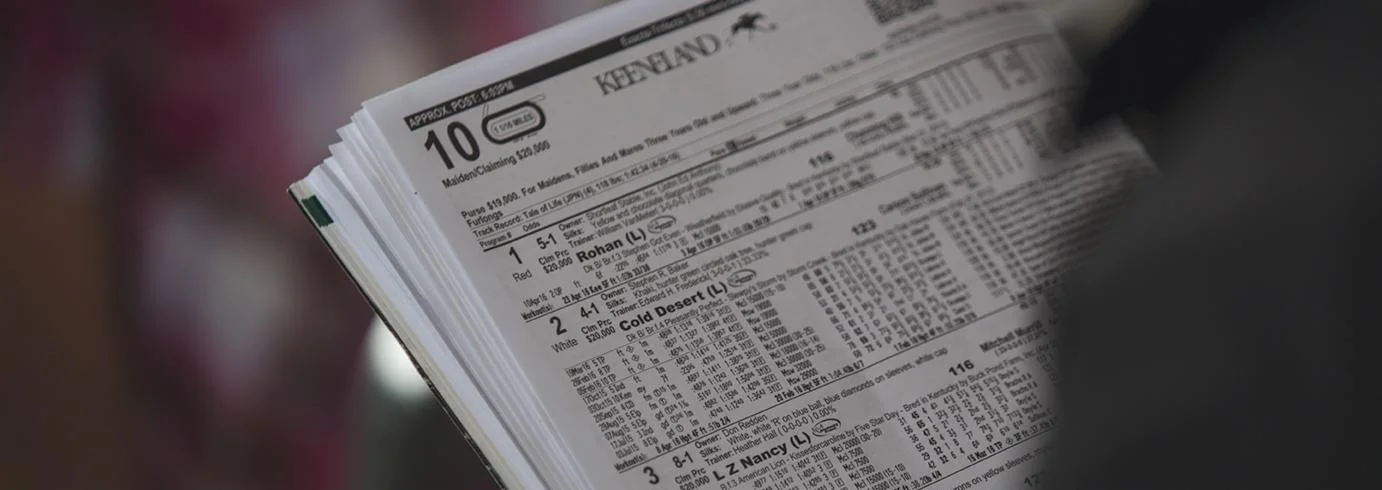
Keeneland offers a concrete example. Its handicapping tools page describes complimentary digital programs during its spring and fall meets. Its official coverage page links to the full-card YouTube broadcast on race days and to race replays. These are specific published resources, rather than a promise that every track provides the same access throughout the year.
Match the program and replay to the right race
Use three identifiers together: track, local race date and race number. A horse's name alone is not enough to identify its next start, and Race 5 without a date could point to many different contests. Start with the today schedule, locate the appropriate meet and card, then match the official program to that card.
Before making a practice selection, check the published changes. A runner listed in the original program might no longer start, and a surface change could alter the question you intended to study. Record what you knew before the race. Updating a paper ticket for a known scratch is different from replacing an unsuccessful selection after watching the finish.
Afterward, use race results to find the relevant contest, then consult the corresponding official chart or result and replay. Keep the winner's placing separate from the ticket's return. For paper accounting, copy the payout for the exact wager and its published base amount; a trifecta return does not describe the price of a win selection.
For watching rather than studying every runner, the free viewing guide helps locate announced official options. Check the program's time and access conditions before settling in. A stream being free to view does not imply a free wager, and a race being televised does not oblige you to bet on it. Keeping those choices separate makes it easier to enjoy the sport on your own terms.
Decide whether an offer fits your planned racing session
Plan the racing first, then consider the offer. If you intended to watch one stakes race, a reward requiring activity across several unfamiliar cards changes your evening rather than merely improving it. If you intended to practice without money, depositing to unlock a match changes the activity altogether. Judge that change against your original purpose.
Write a one-sentence version of the offer: “After I do this, I receive this, which I can use here until this date.” Add your cash outlay and the conditions for any eventual withdrawal. If you cannot complete that sentence from the actual terms, the headline is not enough to make the decision. Keep a copy of the relevant offer and accepted ticket if you proceed, so a support question can concern a particular transaction rather than a remembered advertisement.
A sensible reward should fit an existing limit. TwinSpires' responsible-wagering guidance recommends setting time limits, avoiding loss chasing and treating wagering as entertainment rather than income. An offer's deadline is not a reason to abandon those boundaries. Expired credit is different from an obligation to place a last-minute bet.
When the purpose is simply to learn, a program and an honest paper record are often sufficient. When it is competition, look for a genuinely announced free-entry contest with readable rules. When it is a promotional wager, examine its funding, qualification and settlement conditions separately. None of those choices requires calling every racing-related resource a free bet.
The most useful question is therefore personal and specific: does this option help me enjoy the races I planned to follow, at a cost and commitment I already accept? A clear yes may make the reward relevant. An unclear answer is a good reason to keep watching, studying or practicing without it.
Join the conversation
Have a question or a race-day tip to share? Keep it friendly and on topic. Comments appear after review.
No comments yet. Start the conversation.
Sign in with Google to leave a comment.