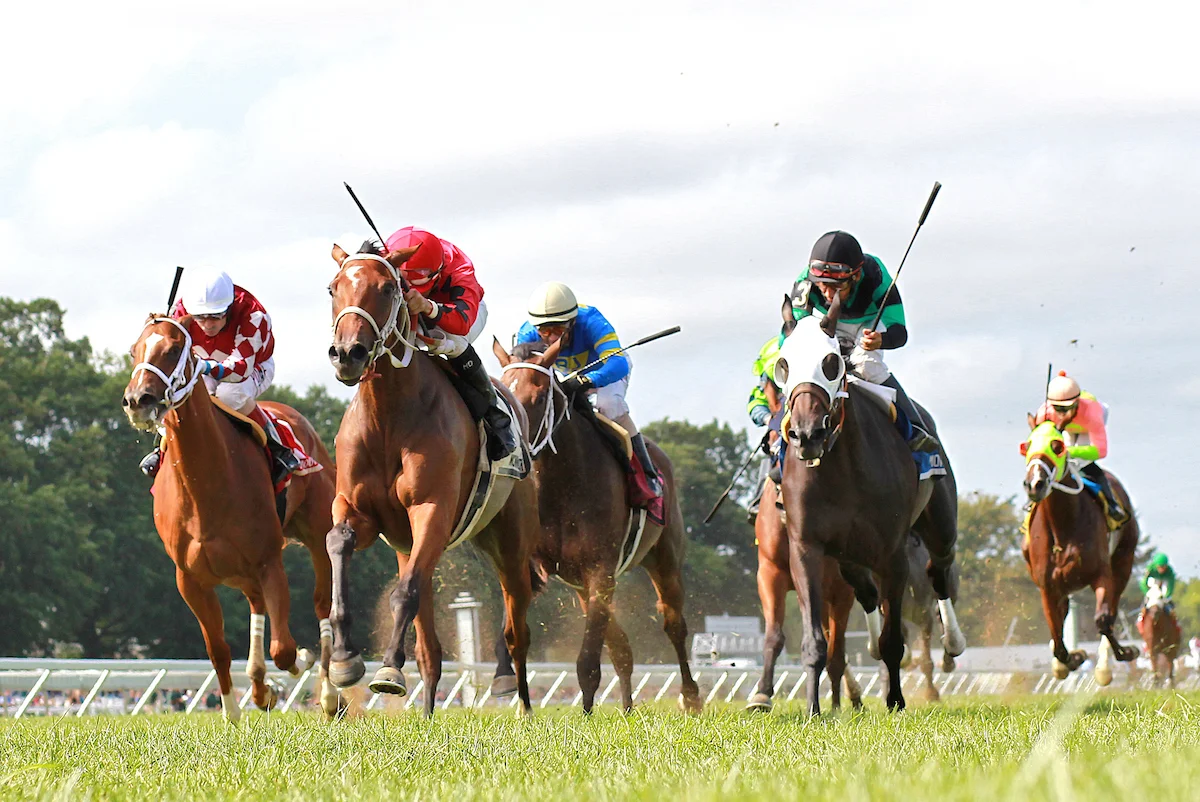
The fastest horse breed depends on the race being measured. Quarter Horses are the essential starting point for short-sprint comparisons, while Thoroughbreds demonstrate speed across different flat-racing distances. Harness racing and endurance impose other tests. To compare them fairly, keep the distance, timing method and sporting rules beside every speed number.
The fastest breed depends on the test
For a short sprint, the American Quarter Horse is the breed to investigate first. For a longer flat race, Thoroughbreds provide a different demonstration of speed. Neither answer supplies a universal league table in which every individual of one breed outruns every individual of another. The distance and the way the performance is measured belong in the answer.
A 2006 study by B. D. Nielsen and colleagues illustrates the problem. Researchers compared race-video segments and found Quarter Horses faster than Thoroughbreds over a comparable short distance when timed from a standing start. Their abstract also identifies a timing difference: Quarter Horse races began at gate opening, while the Thoroughbred and Arabian races examined were timed after a short run-up.
That makes the result more useful than a bare top-speed claim, but it also defines its limits. It is evidence from the races studied, using a stated method. It is not a test of every breed under every condition or a guarantee about the next field. When someone says a horse is “the fastest,” ask what competition, distance and measure they mean.
Average race speed is different from a momentary peak
Average speed is distance divided by elapsed time. A momentary peak is the greatest speed reached during part of the effort. A horse accelerates, may change pace and can slow before the finish, so those quantities need not be equal. A race's final time alone cannot reveal the fastest instant within it.
Take a purely hypothetical 1,000-meter run in 60 seconds. Its average is about 16.67 meters per second: 60 kilometers per hour, or about 37.3 miles per hour. The arithmetic does not tell you whether the runner briefly went much faster. It also does not tell you how fast the same runner would average over a different distance. The example is a calculation, not a recorded performance by a named horse.
Before comparing two published numbers, put their descriptions beside them. Were both averages over the full stated distance? Was the start included? Were the distances identical, and were the horses performing the same kind of race? If one number describes a brief peak and the other a longer race average, sorting them from highest to lowest conceals the difference rather than explaining it.
For a fan, the better question is what speed the sporting task demands. A fast start, sustained pace and the ability to finish after a longer effort can each matter in different races. Recognizing the task makes the clock more informative without requiring you to declare one breed superior at everything.
Why Quarter Horses excel in short races
Quarter Horse racing concentrates the contest into a short distance. There is less room for a leisurely start followed by a long recovery, so the opening of the gates is central to the viewing experience. The fascination is not simply a high speed number: it is how rapidly the runners turn a standing start into a competitive race.
A standing start puts acceleration at the center
In the Nielsen study, the Quarter Horse clock included the departure from the gates. The researchers also reported that Quarter Horses racing 336 meters or less gained speed through the race segments examined. That finding describes those sampled short races; it does not mean every Quarter Horse accelerates continuously in every event.
Watch the start before judging the finish. Which runner gets away cleanly? Which quickly establishes a position beside the others? Does a horse have to recover from losing ground at the break? Those observations help explain the performance you have just seen. They are more informative than assuming that the horse with the most imposing appearance must possess the fastest acceleration.
A runner can be quick without winning its particular contest. The field, the start and the ability to complete the stated distance remain part of the assignment. Breed-level evidence gives you a framework for understanding the sport, while the actual race decides which individual performed best on that occasion. Keep those two levels separate when describing a winner.
Read the distance before comparing the clock
The breed's name does not make every event a quarter-mile. A quarter-mile is 440 yards, or 402.336 meters, but the race heading may specify another distance. For a concrete example, Equibase's October 3, 2026 Lone Star Park card lists Race 1 as a Quarter Horse event over 550 yards on dirt. That is 502.92 meters, a different task from 440 yards.
Read the complete race heading before turning the final time into a speed comparison. Record the distance, surface and date alongside the clock. A result over 550 yards should not be placed beside one over 440 yards as though the faster raw time identifies the faster horse. Even converting both into an average speed leaves the different lengths of effort to explain.
If you want to see the discipline in context, use the Lone Star Park schedule to find the relevant meet and individual race, then confirm the day's official card. The October 3 entry is a dated example, not a promise about today's runners. That simple habit lets you enjoy the sprint while understanding exactly what the horses are being asked to do.
Thoroughbreds combine speed with a longer racing task
A Thoroughbred's sporting task is not always the same, even within a championship meeting. A sprinter and a longer-distance runner face different demands. Calling the breed fast is a useful beginning; calling every member of it suited to the same distance is not.
The official 2026 Breeders' Cup schedule makes that distinction visible. The Sprint is listed over six furlongs on dirt, while the Classic is over 1¼ miles on dirt. They are separate championships with different distances, rather than two equivalent opportunities to produce the smallest number on a stopwatch.
In a longer race, watch how the runner reaches the finishing stage. Did it contest an early lead, travel behind the leaders or wait farther back? What work did it have to do before the decisive moment? You can appreciate a powerful finish without assuming that its final stretch represents the same test as acceleration immediately after a short-race start.
The distinction also helps when following a horse through the season. Compare its actual assignments, not merely the winning time in each result. Moving between distances changes the question you are asking of its record. A spectacular performance over one distance is evidence of that performance; it does not by itself settle every later assignment.
Winning Brew's record has a specific distance and date
Guinness World Records' public record page, checked on October 11, 2026, lists Winning Brew at 70.35 kilometers per hour, or 43.71 miles per hour, over two furlongs. The two-year-old Thoroughbred filly covered the distance in 20.57 seconds at Penn National in Grantville, Pennsylvania, on May 14, 2008. Those details belong beside the speed.
The description relates the number to a stated distance and elapsed time. It should not become a claim that no horse can ever reach a higher instantaneous speed, or that the same average would be maintained through a much longer event. The page also cautions that changing records are not immediately published online. Describe what the listing says, with its scope and date, rather than turning it into an unrestricted claim.
This is why a Thoroughbred record and the Quarter Horse study can appear together without contradiction. They answer differently framed questions using specific performances and methods. One identifies a published record over two furlongs; the other compared sampled race segments and standing-start speeds. The responsible comparison preserves those descriptions instead of stripping them away to create a debate between two bare numbers.
Use the major-race calendar to choose an event, then read its individual distance and surface. The exciting part is seeing how a horse meets that particular challenge. Its breed helps orient you; the race conditions tell you what achievement you are about to watch.
Standardbreds and Arabians answer different questions
A broader discussion of racehorse breeds needs to identify what the horses are competing in. Standardbreds in harness racing and horses in long-distance endurance events demonstrate forms of athletic performance that a short galloping-speed table does not capture. Their results become more interesting when you understand the rules of their own contests.
Harness racing measures speed within a gait
The U.S. Trotting Association's fan guide separates harness races into pacing and trotting. Pacers move the legs on the same side together; trotters move diagonal pairs together. Runners in a race compete at the same gait. The driver rides in a lightweight racebike, or sulky, rather than on the horse's back.
Maintaining the gait is part of the test. A horse that begins galloping has gone off stride; it has not discovered a legal way to win by switching to the gait used in a Thoroughbred race. Avoid interpreting that moment as an acceleration triumph simply because the movement looks faster. Watch whether the horse maintains its rhythm and how that affects its position.
USTA describes harness races as almost always a mile. That familiar distance gives fans a useful frame, but the actual race heading remains the place to confirm it. The contest is not the same as a mounted galloping race over a mile: gait and equipment differ. A comparison that ignores those conditions reduces a distinct sport to an unexplained clock time.
When first watching harness racing, choose one runner and follow its position relative to the others. Notice whether it travels behind a rival or spends time outside, and whether it stays on gait throughout. These observations let you appreciate a competitive performance within the rules, rather than judging the breed against a completely different sporting assignment.
Endurance is a separate sporting test
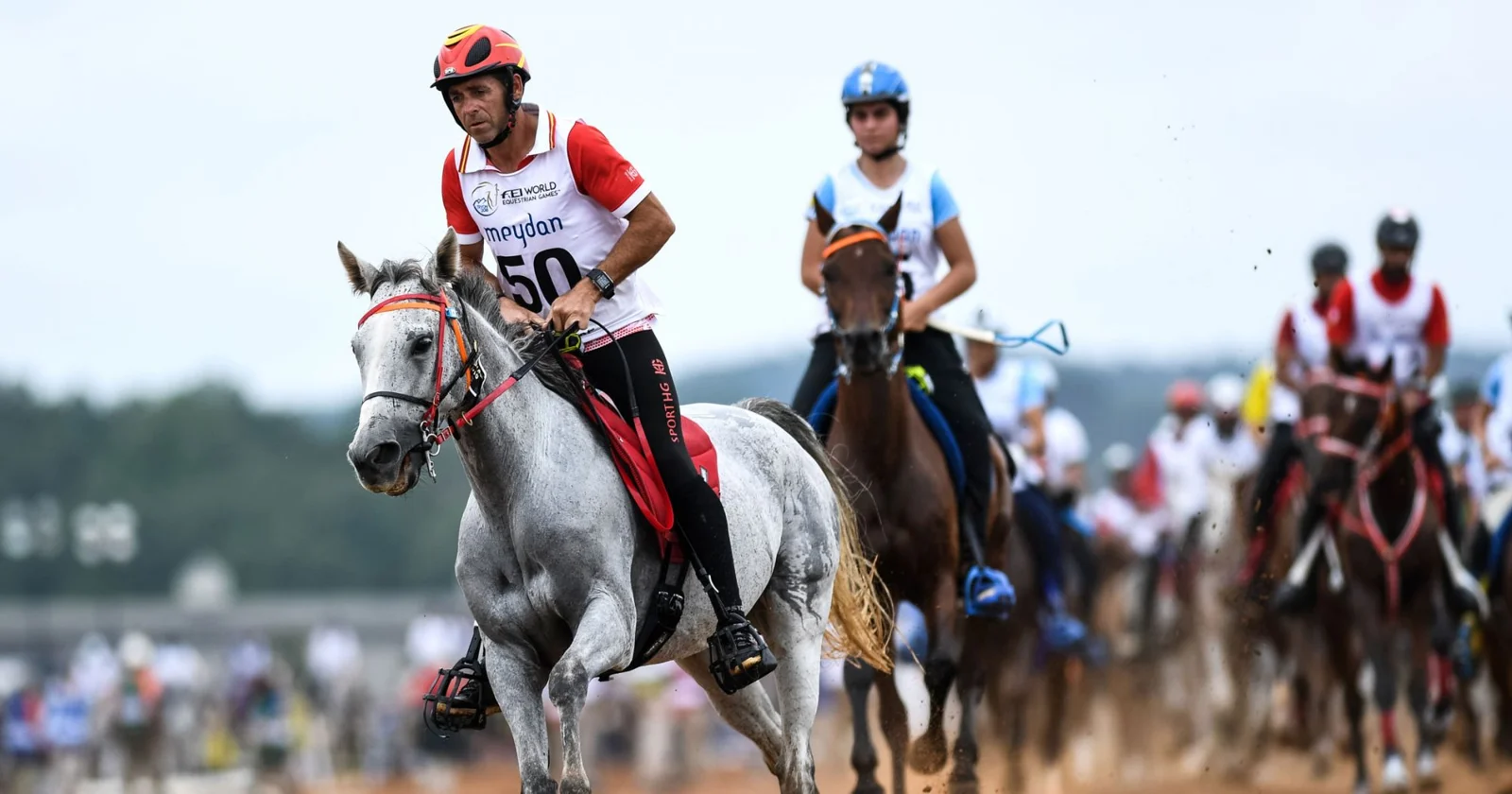
Arabians should not be confined to a single label. The Arabian Horse Association describes purebred Arabian racing for prize money in the United States and notes that some former racehorses move into endurance. A track race and an endurance ride are different competitions, even when an individual horse has experience of both.
In its January 2024 introduction to endurance, the FEI describes international distances extending to 160 kilometers, organized in loops with veterinary inspections and rest periods. Horses must be considered fit to continue. The task involves completing a long effort within welfare requirements, rather than merely producing a brief maximum speed.
For spectators, that changes what counts as useful evidence. A quick opening section is only part of the event, and the clock does not replace the horse's eligibility to continue. A lower average speed over a long endurance course does not imply a lesser athlete than a short-race sprinter. It describes an athlete answering another question. Follow the particular competition's results and requirements before transferring conclusions from a sprint to a day of endurance.
Use breed comparisons to understand the race you are watching
A useful comparison begins with a complete description of the achievement. Keep a simple note containing the breed or discipline, race distance, date, surface or course, timing method and what the number represents. Add the source of the result. You now have enough context to decide whether another performance belongs beside it.
Official record categories show why those details matter. The USTA's North American records distinguish gait, age, sex and track size. They do not treat every mile as an identical record category. Preserve a record's category when discussing it, rather than presenting a category winner as the answer to every possible version of “fastest horse.”
Also identify whether a number is a speed or a rating. DRF describes Beyer Speed Figures as a way to compare race performances while accounting for time and the track. A figure is not a miles-per-hour reading. A runner receiving a higher figure has not necessarily produced a new raw-speed record, and the number cannot be inserted into a table of kilometers per hour.
For your next viewing session, use a short sequence:
- Identify the individual race and discipline, rather than relying on the track's name alone.
- Read the distance and surface or course before inspecting the final time.
- Watch the start, the development of the contest and the finishing stage.
- Locate the result and compare the observed performance with the particular task.
The today's schedule tool can help you find a meeting and race. Afterward, our race results can help locate the contest, while its corresponding official result or chart supplies the primary record. Do not assume a short race at one venue and a longer race at another become equivalent merely because both appear in the same day's timetable.
This approach leaves room for different kinds of excitement. You may enjoy the immediacy of a Quarter Horse sprint, the unfolding pace of a Thoroughbred race, the rhythm of harness racing or the sustained challenge of endurance. None requires an invented top-ten speed ranking to be impressive. The comparison should explain the achievement you watched: how far, under which conditions and within which sporting rules the horse performed.
Join the conversation
Have a question or a race-day tip to share? Keep it friendly and on topic. Comments appear after review.
No comments yet. Start the conversation.
Sign in with Google to leave a comment.