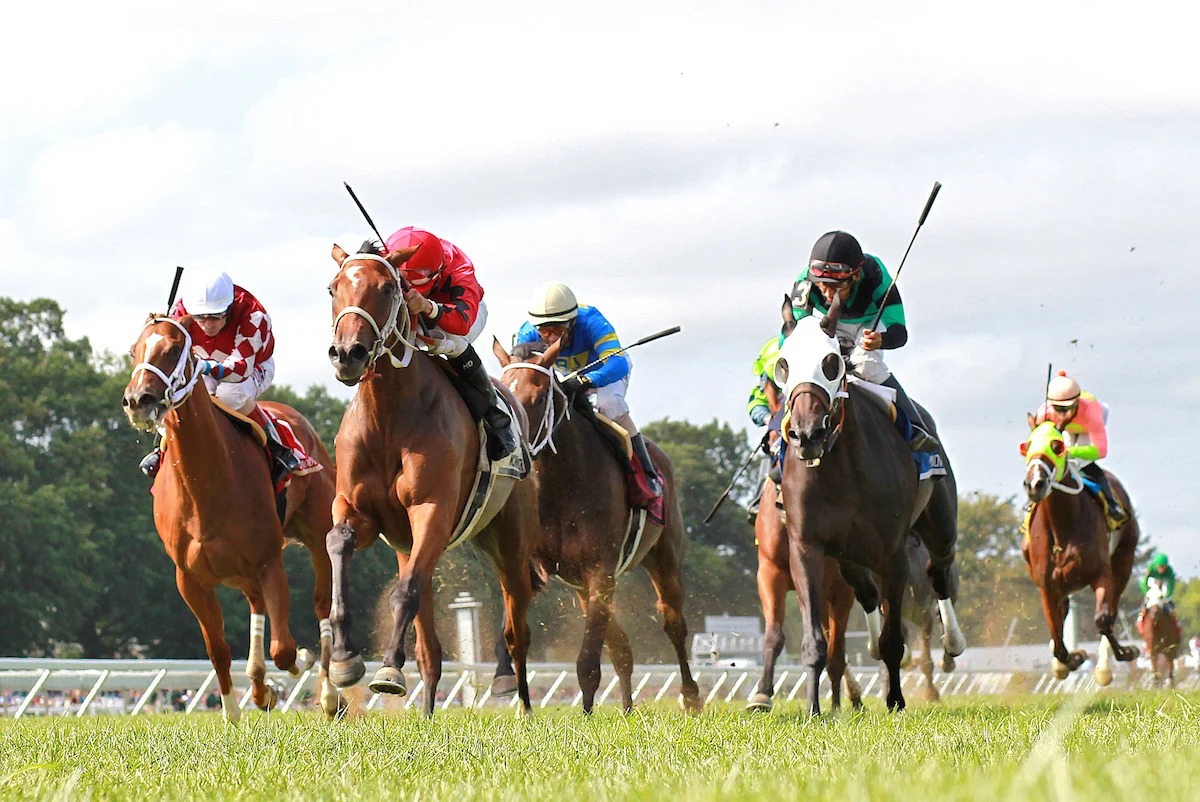
1/ST BET brings race selection, form, replays and wagering into one racing service. Using it well starts with the correct product and account eligibility, then a clear route from the meeting to the racecard, ticket review and accepted-wager record. This guide uses official information checked in October 2026 to explain that sequence and the money rules behind it, without treating app rankings or a welcome offer as a guarantee of winning.
Get the right 1/ST BET product before opening an account
1/ST BET is a horse racing wagering product, so your first job is to identify the correct service and establish whether it can accept your account. A familiar logo on a racecourse advertisement does not complete that check. Begin with the operator's own links rather than a third-party download page or a search result promising an unusually generous offer.
App Store access is different from permission to wager
The official Apple listing identifies Xpressbet, LLC as the developer. When checked in October 2026, it required iOS or iPadOS 15.1 or later. Check the current compatibility section on your own device before downloading. The listing also links to other racing products, including 1/ST BET PRO; a similar brand name is not proof that two applications have identical features, accounts or balances.
The official browser service provides another starting point. On a device without a confirmed official native download, use that verified route rather than an unofficial installation file. A free download means that obtaining the software has no listed purchase price; it does not make real-money tickets free. Likewise, the store's age label is not a substitute for the requirements of your jurisdiction and account.
Check your account eligibility and the race-specific location rules
Read the operator's current account conditions and check with the relevant racing regulator if your situation is unclear. The 1/ST BET terms require lawful account use and address wagering when traveling. Do not assume that eligibility at home continues unchanged on a trip. Your account should be personal, and a successful installation should never be treated as permission to place a wager.
Some restrictions concern the particular racing you want. Canterbury Park's instructions specify a designated on-property wagering deck and location access for betting its races. That is a useful example of why an app's national availability does not settle every track-specific question. Confirm the rules for the meeting and location involved before funding an account or planning to use the app from home.
Find the meeting and understand the racecard
Begin with the meeting you intended to follow, rather than the first race approaching post time. The public 1/ST BET service separates Today, Favorites and All Races, alongside carryovers and expert picks. Favorites can help return you to a chosen circuit, but their usefulness depends on making the initial selection correctly. They should organize your afternoon rather than supply a reason to bet an unfamiliar race.
Check the venue, date and race number together. A hypothetical Race 7 at Santa Anita and Race 7 at Gulfstream are separate contests even if both appear nearby on the screen. If you arrived from a famous race's promotion, verify that you have opened the featured event rather than another race on the same card. Our today's schedule can help you identify the meeting, followed by the operator's current card for the wager itself.
Read the race conditions before the names: distance, surface and the type of contest matter to the interpretation of previous performances. Then check the runner's name and betting number, jockey and trainer, and any late changes. Canterbury's official app instructions identify jockey and trainer labels and distinguish morning-line from current odds. Keeneland's morning-line definition is useful when that label interrupts your reading.
A morning line is an estimate prepared before the public betting develops, not a reserved return for your ticket. A program or betting number identifies the selection; the starting stall describes its draw. Keeping those concepts separate matters more than memorizing where every button sits, particularly when runners change position in a list or a coupled entry appears.
Do not treat a minutes-to-post display as a promise about the exact start. Use it as a cue to pay attention and recheck the card, while allowing time for your decision. A broadcast can begin well before a particular race; our television schedule serves that separate viewing task. The racecard is where you resolve which horses are competing in which contest. Getting that identification right prevents a polished app interface from simply making the wrong race easier to select.
Use past performances and replays to test a racing opinion
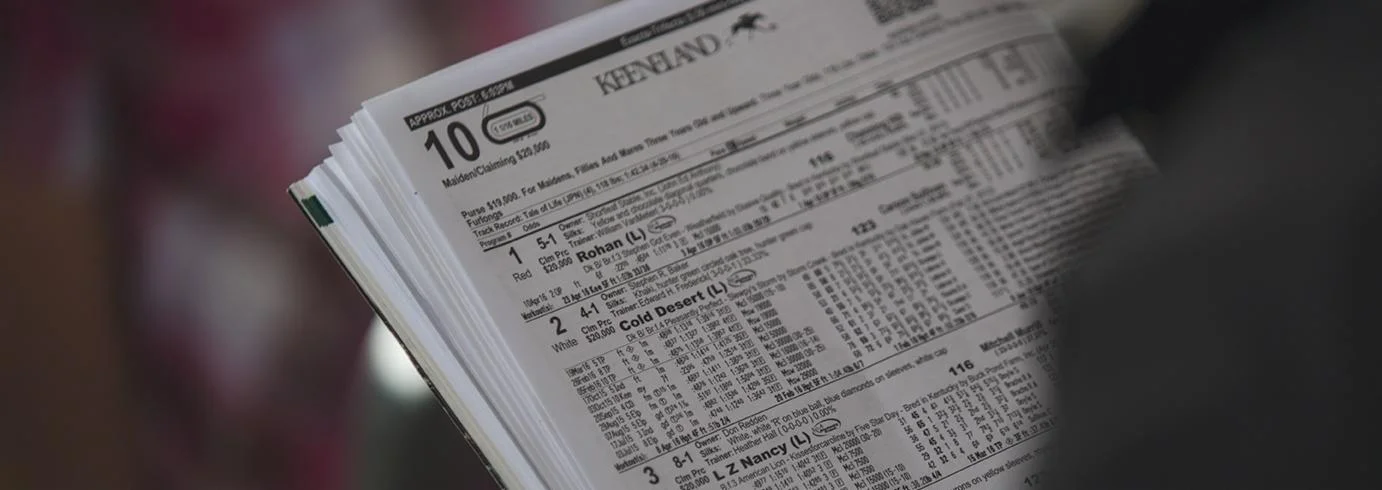
The useful part of having form information beside a betting card is that you can ask a specific question and check it without losing the race you are studying. The operator's feature description highlights six recent running lines and replays accessible from past performances. Start with the most relevant previous contest rather than assuming that the newest line alone tells the whole story.
Compare its surface, distance and competition with the upcoming assignment. Then watch for how the performance happened: whether the horse settled comfortably, had clear running room and sustained its effort, or benefited from circumstances unlikely to recur. A hypothetical fourth-place finisher that traveled wide has presented a different question from a leader that set an uncontested pace and faded. The finishing positions alone cannot resolve either case.
Use the replay to test an observation, not to manufacture an excuse for a favorite. Write down what you actually saw and what it might mean in the next race. If a crucial incident is not visible, leave it unresolved rather than supplying a confident explanation. For a deeper look at one circuit, official resources such as Keeneland's programs and statistics provide additional context; they are not a substitute for identifying the correct horse and date in the app.
A ranking is a starting point, not a guaranteed winner
The app listing describes analysis of speed, pace, competition and connections. Such categories are useful questions to investigate. A horse's place in one ranking tells you how it compares under that measure, not that it must win this field at this distance. Several related speed categories can also reflect much of the same evidence; counting them as separate reasons may exaggerate the strength of your opinion.
A September 2022 operator example presented win, place and show projections beside morning-line odds. It illustrates distinct concepts, not a current prediction for today's card. A forecast percentage remains an estimate and needs evaluation over appropriate races; it is not proven accuracy merely because it looks precise. Use a ranking to decide what deserves closer reading, then compare that evidence with the race conditions and uncertainty. You can enjoy testing the opinion without turning every attractive figure into a ticket.
Build the ticket and confirm what was accepted
Your racing opinion and the ticket that expresses it are separate things. Start by choosing a bet type you understand and a base amount permitted for that pool, then add the correct betting interests. Canterbury's guide describes a review step followed by placing the bet. The layout may change between versions, but that distinction remains useful: preparing selections is not the same as having a wager accepted.
Separate the base amount from the total ticket cost
An exacta requires the first two finishers in the correct order. Boxing selections covers their possible orders, which increases the number of wagers. Suppose a pool permits a $1 base and you choose separately numbered betting interests 2, 5 and 8, with no coupled horses sharing a number. The six orders are 2–5, 2–8, 5–2, 5–8, 8–2 and 8–5. The hypothetical box therefore costs $6.
Adding a fourth separately numbered interest produces twelve orders and a $12 ticket. You have doubled the spending while adding only one more selection to the visible list. The standard combination explanation helps check that arithmetic; the actual host pool still determines its permitted minimums. A small base amount is not a small total by definition.
At review, read venue, date, race, wager type, selections and total cost together. Check whether the app has expressed your opinion in the intended finishing positions. A straight exacta and a box can contain the same two numbers but purchase different outcomes. Do not let an approaching start pressure you into buying a structure you have not understood.
Check the receipt before trying again
The operator's terms identify an electronic confirmation with a valid transaction reference and the words “Bet Accepted.” That is stronger evidence than a button press, a changing balance or a video continuing to play. Keep the reference available and inspect the relevant wager record if the outcome of submission seems uncertain.
Check that record before repeating the same request. Otherwise an attempt to fix an unclear screen may purchase a second ticket. Cancellation should not be your planned remedy: the terms allow the operator to limit cancellations and do not guarantee success. Leave time for the review, and pass the race if you cannot establish what you are buying. A careful accepted-ticket check serves you better than demonstrating how rapidly you can navigate the app.
Understand funding and promotional credits
Decide how much you are prepared to spend before visiting the funding screen. Read the total charge and available methods for your account, then find the separate withdrawal conditions. Money arriving in a wagering balance and money reaching your bank are different tasks. A venue guide describing a convenient payment method cannot establish the timing of every individual's withdrawal.
The operator terms checked in October 2026 distinguish opening the account from its initial deposit requirement, including a different minimum for Massachusetts, and describe deposit fees that may be waived or reinstated. That is a reason to inspect the actual transaction you are authorizing, rather than carry a remembered fee from a review. Ask support about documents, transfer clearance or a pending request before assuming the balance is immediately withdrawable.
Follow the terms of the offer you actually received
Different routes into the product may display different promotions. Match the code, eligibility and deadline in your account to the corresponding full terms. A store description, an affiliate review and an operator landing page should not be combined to invent a better offer than any one of them actually makes. Save the applicable conditions and note whether cancelled or refunded wagers qualify.
For a dated example, the official AUTUMN500 terms checked in October 2026 describe $10 credit for each $100 of qualifying wagers during the first 90 days, with a $500 maximum based on $5,000 wagered and an advertised sign-up deadline of November 8, 2026. They distinguish credit from withdrawable cash and give unused credits a 14-day expiry. Those details belong to that offer, not every future promotion.
Under the described increments, $1,000 of qualifying wagers corresponds to $100 of credit. It does not correspond to $100 profit: the wagers themselves can lose, and the credit has restrictions. The maximum requires far more activity than the headline alone suggests. This arithmetic explains the offer, not a suggestion that you should pursue its highest tier.
Compare the conditions with the racing you already planned to follow. If reaching another reward would mean buying additional tickets you did not intend to buy, the promotion is changing the session. Leaving part of an advertised maximum unearned can be the sensible outcome. The account should serve your interest in the horses and your spending boundary, rather than the other way around.
Review the session and know where to get help
After the meeting, compare what you expected with what happened rather than immediately looking for another race. Use the wager history to identify accepted tickets, their costs and their settlement, then return to the relevant replay. Our race results can help locate the contest; the corresponding official result and the operator's receipt resolve the outcome and account settlement.
Keep the racing lesson separate from the money calculation. A correct observation about the pace can still lead to a losing ticket, and a winning ticket can result from an outcome you did not anticipate. Compare returns with the full cost of all tickets in the session. A deposit increases the displayed balance but is not a racing profit; a withdrawal reduces it but is not a racing loss. Refunded stakes should also be distinguished from winnings.
For an account question, gather the race identity, transaction reference and a concise explanation before contacting the operator. The current public service lists 866-889-7737 for assistance. Use the verified contact route and follow its instructions for account identification; do not post passwords, private documents or ticket references publicly in an attempt to get an answer. A delayed response is not a reason to repeat an uncertain wager.
The operator's account-control information describes rolling seven-day funding limits and restrictions on funding methods, requested through support. It also explains permanent account blocking in connection with a potential gambling problem and says such a block cannot be removed. Understand the control you request rather than assuming that every closure is a short pause. Follow the relevant state resource when seeking a broader self-exclusion option.
A sensible routine ends where you planned it to end. Keep a short note of the races you understood, the uncertainty you left unresolved and any feature that caused confusion. That gives the next visit a useful starting point without requiring another deposit today. The strongest reason to use a racing app is clearer access to the sport and a clearer record of your own decisions. Neither a convenient replay nor a well-presented prediction requires you to buy the next ticket.
Join the conversation
Have a question or a race-day tip to share? Keep it friendly and on topic. Comments appear after review.
No comments yet. Start the conversation.
Sign in with Google to leave a comment.